Digital advertising doesn't look anything like it did two years ago. The endless cycle of manual tweaks, gut-feel decisions, and A/B tests that took weeks to run? Mostly gone. In its place, we've got something that genuinely surprised me with how fast it arrived: advertising that thinks, creates, and adapts on its own.
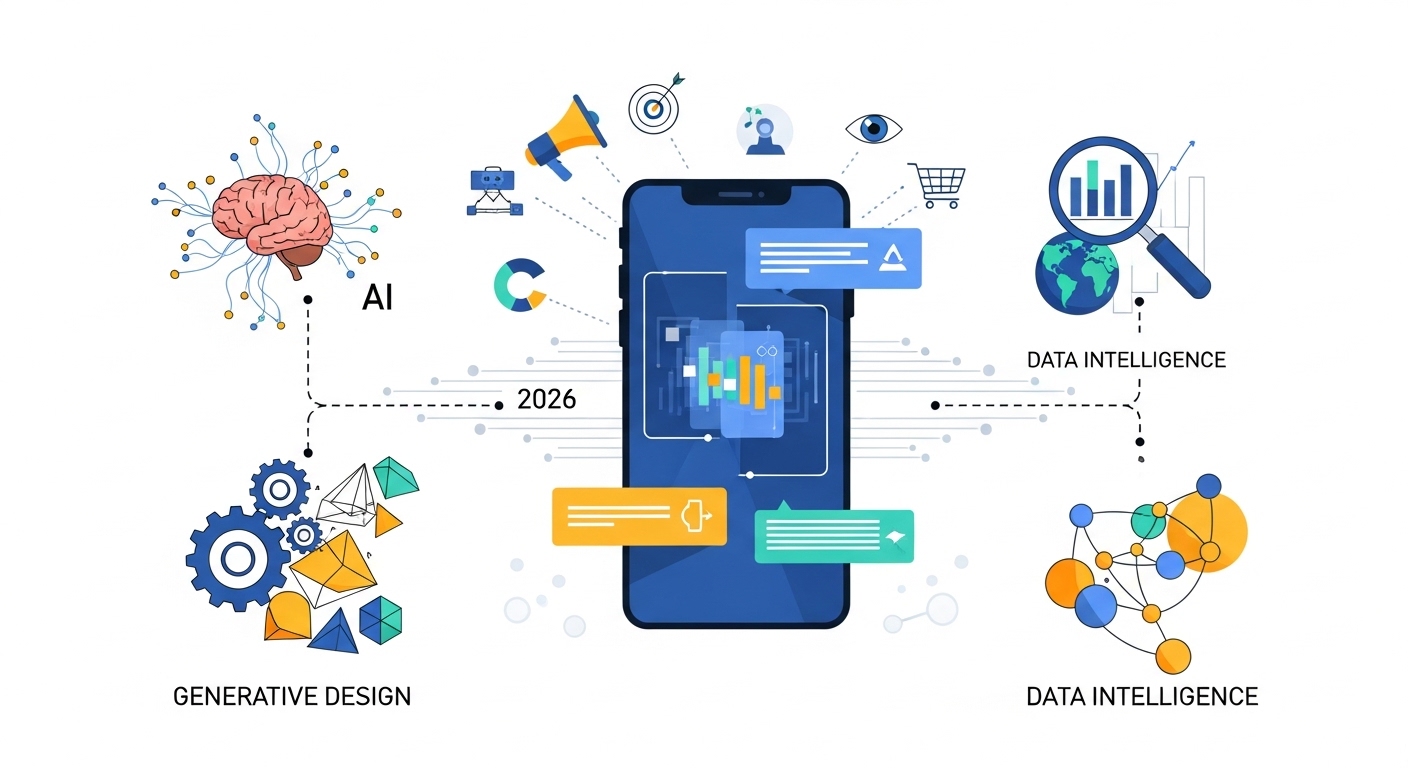
Three things are driving this. AI is the decision-maker. Data Intelligence feeds it the context it needs. Generative Design handles the creative output at a speed no team could ever match. They work together, and once you see them in action, it's hard to imagine going back.
AI: The New "Agentic" Marketing & Automation
The phrase getting thrown around is "agentic AI," and it's not marketing fluff. These systems take real initiative. They launch campaigns, watch the numbers, kill what's failing, scale what's working, and they do it without someone hovering over a dashboard.
Campaign management has basically run itself for the past year. Bids, budgets, audience targeting, all of it shifts in real time. I used to spend Monday mornings adjusting settings across a dozen accounts. That ritual is dead, and I don't miss it.
What's more interesting is how AI agents now build campaigns from the ground up. You give them a goal, they handle the rest. The role of the marketer has shifted upstream, toward strategy, brand voice, the things that actually require human judgment. Which, honestly, is where we should have been spending our time all along.
Search is the other big shift. Traditional SEO is fading because people aren't clicking links anymore. They're getting answers directly from AI, and that means Answer Engine Optimization (AEO) is the new game. If your content isn't structured to be the answer, you might as well not exist.
Designing Digital: Hyper-Personalized Design
Remember when launching a campaign meant briefing a designer, waiting a week, going through three rounds of revisions, and ending up with one ad? That whole workflow is over.
Generative design turned creative visualizers into a pipeline that never stops running. Brands aren't producing "an ad" anymore. They're producing thousands of variations, each one tuned to a specific moment, mood, or person.
Dynamic Creative Optimization is the engine behind a lot of this. Visuals shift, copy rewrites itself, offers change based on who's watching. Two people scrolling past the same campaign will likely see two different versions, and neither will know it.
Video and AR used to be expensive. Now you type a prompt and get a finished video ad, a custom avatar, or an AR experience that would have cost a six-figure budget in 2023. The playing field has flattened in a way that benefits scrappy brands far more than the giants.
Static ads went the same direction. Platforms generate hundreds of variations, predict which ones will perform, and only push the winners live. It's like having a focus group running every hour of every day.
Data Intelligence: Predictive and Privacy-First

Third-party cookies are gone, and the industry is better for it. What replaced them is more powerful and a lot more respectful: AI that reads behavioral signals to understand what people want, often before they've figured it out themselves.
Predictive analytics is doing the forecasting heavy lifting. Pull in historical patterns, run them through the right models, and you can see where things are heading. Brands are allocating budgets based on what's coming, not what just happened.
Contextual targeting made a comeback I didn't expect, and it's much sharper than the old version. AI now reads the actual content of a page, the themes, the tone, even the emotional pitch, and places ads where they fit. No tracking. No following people around the internet. Just relevance based on the moment.
The bigger story is privacy-first AI. Zero-party data, the stuff people willingly share, has become the new currency. It keeps brands compliant, but more importantly, it builds trust. And trust, it turns out, is the only competitive advantage that actually lasts.
The 2026 Landscape at a Glance:
| Component | What Changed | Where We Are Now |
|---|---|---|
| Strategy | Reactive → Predictive | Modeling outcomes before launch |
| Creative | Static → Dynamic | Endless personalized ads built in real time |
| Targeting | Demographic → Intent-Led | Behavior and context beat age and zip code |
| Workflow | Linear → Agentic | Autonomous systems running end-to-end |
The Skills That Actually Matter Now
If you work in this field, the job has changed. Here's what separates the marketers who are thriving from the ones falling behind.
You need to know how to design AI workflows. Plugging AI into your research, content, and reporting isn't a bonus skill anymore. It's table stakes.
Prompt engineering matters, but oversight matters more. AI will produce confident garbage if you let it. The marketers winning right now are the ones who can guide these systems and catch their mistakes before they go live.
Data fluency is non-negotiable. You don't need to be a data scientist, but you do need to read AI insights, spot what's real, and run experiments fast enough to keep up.
And finally, ethics. Privacy, bias, transparency. These aren't soft topics anymore. They're the foundation. Get them wrong and you lose the trust your whole strategy depends on.
Wrapping This Up
Digital advertising in 2026 isn't just faster. It's a different game. The brands winning aren't the ones with the deepest pockets. They're the ones who figured out how to partner with AI instead of fighting it, who treat data like a trust agreement instead of a resource to mine, and who let creativity scale without flattening it into noise.