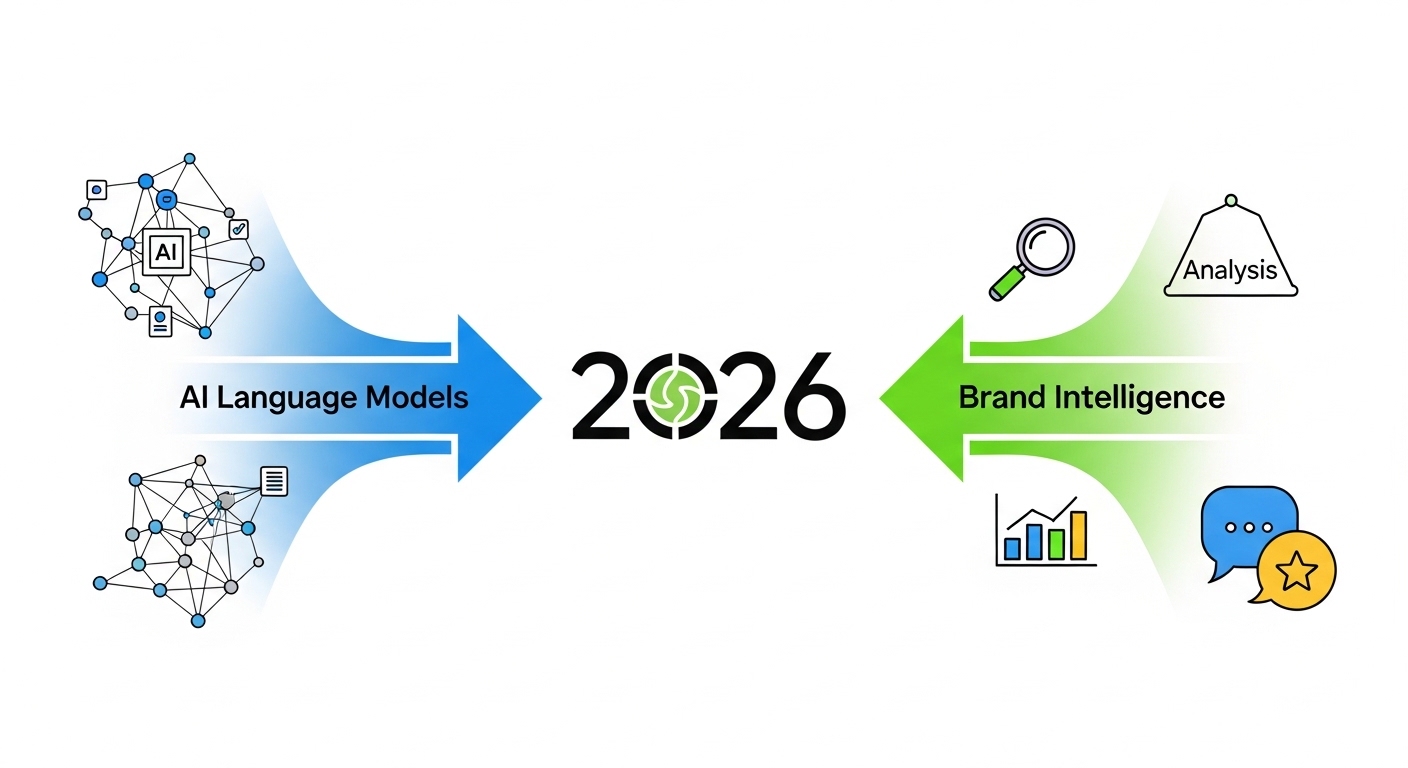
Brand strategy is no longer just about identity. It is about intelligence.
In 2026, the brands winning the attention economy are not the loudest. They are the smartest, most adaptive, and most strategically fluent. AI has moved from the marketing department into the core of a brand itself, reshaping how companies communicate, compete, and connect with audiences in real time.
From Static Identity to Living, Adaptive Brand Systems
Traditional brand guidelines were built to stay consistent. AI-powered brand systems are built to respond.
Brands can now evolve in real time, adjusting language, visuals, and tone to reflect how audiences feel at any given moment. An adaptive system learns:
- Which imagery works better for a 24-year-old on mobile vs. a 45-year-old on desktop
- When to use a sharp, playful tone vs. a warm, reassuring one
- How to shift messaging by region, culture, or emotional context without losing brand coherence
Real-world example: Nike's AI brand system modifies its motivational tone by region. It runs bold and assertive in North America, fluid and expressive in Asia-Pacific. That kind of cultural intelligence at scale was simply not possible with a static PDF brand guide.
LLMs and the New Verbal Identity
Large language models have changed how brands produce and manage their voice.
Once a brand trains an LLM on its existing content, the system can generate on-brand copy across every channel, including tweets, product descriptions, emails, and white papers, while maintaining a consistent tone and adapting to different audiences automatically.
Many brands are now working with professional messaging specialists to ensure their core brand voice stays human and distinctive before handing it over to AI systems for scale.
What AI now handles for brand language:
- Auditing content across web, email, and ads for tone and brand voice alignment
- Flagging language drift or inconsistency before campaigns go live
- Shifting tone dynamically based on audience segment or channel
- Maintaining voice consistency across dozens of touchpoints at the same time
The numbers support this shift. In 2026, 91% of marketing professionals actively use AI tools, up from 63% the previous year. The industry has officially entered what analysts call the "operational era" of AI. It is no longer experimental. It is now foundational.
The Rise of Agentic AI Workflows

The most advanced marketing teams in 2026 have moved beyond chat-based AI tools entirely.
They now run multi-agent AI systems, sometimes called an "AI workforce," where dedicated agents learn brand messaging guidelines, access company data, and apply brand rules consistently across every channel without needing human approval at each step.
Why this matters: The bottleneck in content production is no longer the drafting phase. It is now:
- Brand, legal, and compliance review
- Data privacy and IP security checks
- Cross-channel consistency enforcement
The most valuable AI tools today are those that embed these checks directly into the content generation pipeline, not as an afterthought.
Hyper-Personalization at Scale
Personalization in 2026 is no longer a feature. It is the baseline expectation.
AI now tailors brand messaging in real time at the individual level, based on behavior, device type, location, browsing history, and predictive modeling. Instead of one-size-fits-all campaigns, marketing now runs as a living system driven by data feedback loops.
Key numbers that show how far this has come:
- 73% of marketers say AI is now essential for delivering personalized customer experiences
- 91% of consumers prefer personalized brand interactions
- AI-driven personalization has shown significant improvement in conversion rates across industries
A homepage that adapts its hero image and headline based on who is visiting is not just a conversion tactic. It is a branding decision.
Conversational AI and the Voice Identity Challenge
Forrester predicts that 1 in 4 shoppers will use specialty retail chatbots in 2026. The words a brand's AI chooses in those conversations carry enormous weight.
Tone, vocabulary, and response pacing are all brand identity elements now. But there is a serious problem most brands have not solved yet.
AI chatbots and voice interfaces often default to generic personas that do not align with a brand's established tone, which weakens brand identity at the exact moments customers are most directly engaged.
Training conversational AI to sound authentically on-brand, rather than generically helpful, is one of the defining brand challenges of this year.
The LLM Brand Representation Problem
This is one of the most underreported risks in branding today, and most companies are completely unprepared for it.
When consumers use ChatGPT, Gemini, or Perplexity to research products, what the AI says about a brand is now part of that brand's reality, whether the company controls it or not.
A real case: In 2024, Pernod Ricard found that two-thirds of Gen Z consumers and more than half of Millennials had started using LLMs to research products. When the team studied how AI models represented their brands, the results were alarming. Data was often incomplete or incorrect. One major AI model placed Ballantine's Scotch whiskey, an affordable mass-market product, into the prestige category.
What forward-thinking brands now do:
- Run structured prompt tests across ChatGPT, Gemini, Claude, and Perplexity
- Track brand presence, narrative accuracy, and tone across 20 to 50 high-relevance queries
- Audit how AI compares them to in recommendation scenarios
This is no longer optional. Managing LLM brand representation is the new reputation management.
Generative Engine Optimization (GEO):

Most brands are still optimizing for Google. The competition has already moved somewhere else.
In 2025, referral traffic from AI platforms like ChatGPT, Gemini, and Perplexity to e-commerce sites grew by 109%, while traditional referral sources grew by just 7%. The fight for the number one search ranking is giving way to a new battle: being the brand an AI assistant recommends in conversation.
This has introduced two new critical concepts:
- AI Share of Voice: How often an AI assistant recommends a brand versus a for specific natural-language queries
- BrandRank: A scoring system for how AI systems prioritize a brand in recommendations, based on schema freshness, sentiment, authority signals, and citation frequency
The zero-click problem: In LLM environments, users read AI summaries and make decisions without ever visiting a website. A brand may be shaping buyer intent, and standard analytics would never show it. Brands that are not monitoring this are, as one analyst put it, "flying blind."
Visual Identity Design Gets an AI Co-Pilot
Between 2024 and 2026, AI transformed what design teams can produce and how fast they can work.
Key capabilities now available to designers:
- GANs (Generative Adversarial Networks) produce original visual elements not found in training data, which removes the plagiarism concern that surrounded early AI design tools
- NLP-to-visual translation lets designers describe what they want in plain language and receive relevant visual starting points right away
- Real-time rendering shows how an identity system looks across all applications, from packaging to social templates, generated automatically from core identity elements
The best brand identities in 2026 do not look AI-generated. They look more human than ever, because designers now have more time to focus on the emotional details that build real connection. AI handles the mechanical exploration. People handle the judgment.
AI generates the possibilities. Humans make the choices.
Trust, Transparency, and the Authenticity Challenge
As AI takes over more of brand communication, transparency is becoming the most important differentiator.
There is a real tension here. Consumers value authentic brands that stand for something real, yet AI, when used without care, can produce experiences that feel hollow and manufactured. The answer is not to hide AI. It is to use it with intention.
What responsible AI branding looks like in 2026:
- Labeling AI-generated content clearly and consistently
- Building explainability into chatbots and personalization systems
- Publishing AI ethics pages that detail how the brand uses AI responsibly
- Investing in diverse, high-quality training data to avoid bias in brand outputs
One risk that brands often overlook: AI is only as good as the data it learns from. Incomplete, outdated, or biased datasets produce flawed brand insights and misdirected personalization. The quality of brand training data is now as strategically important as the AI tools themselves.
Research sources: Harvard Business Review (March-April 2026), Retail Technology Innovation Hub, Gurkha Technology, Gravity Global, Stormy AI, SurveyMonkey, Forrester, and Spinta Digital.