For years, making short video content script was mostly guesswork. You'd write a hook, shoot it on your phone, post it, and watch the view counter while pretending you weren't watching the view counter. If it hit, great. If it didn't, you blamed the algorithm and tried again on Tuesday.
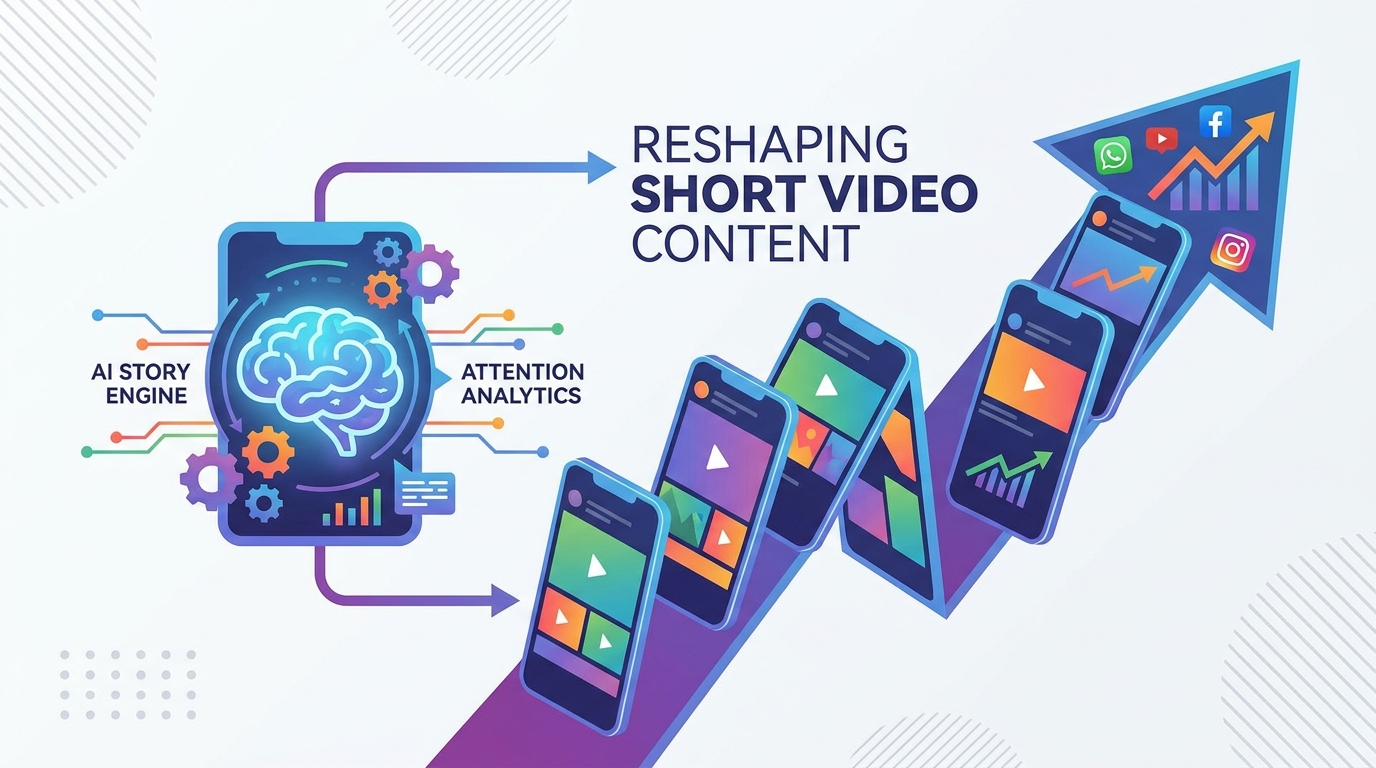
Two things changed in 2026, and they changed at roughly the same time. On one end, AI tools stopped pretending to be clip generators and started behaving like actual story engines. On the other end, every major short-video platform quietly stopped caring about your view count and started caring about how people actually watched. Put those two shifts together and short video isn't a gamble anymore. It's a system.
What an AI Story Engine
An AI story engine isn't another tool that spits out a six-second clip of a fox running through a forest. It's a platform that handles a whole video end to end script, characters, scene-to-scene continuity, voice, editing without you having to stitch anything together yourself.
The reason this category even exists is that 2024 and 2025 had a problem nobody could solve. Call it the continuity crisis. AI could produce one stunning shot, but the second you tried to make a story out of it, the character's face would change, the lighting would shift, and the whole thing would fall apart by the second cut. You could make a moment. You couldn't make a movie.
The 2026 tools fixed this, and they fixed it in four pretty different ways.
- Story67.ai, which launched in January, took the model-agnostic route. It runs your script through OpenAI for the narrative work and Runway for the visuals, and it's built to swap in newer models as they ship. The whole thing is vertical-first designed for mobile and connected TV from day one, not retrofitted from horizontal video.
- GIBO Create went industrial. It's optimized for 1–3 minute episodic content drama, romance, suspense, the stuff that drives serialized binge-watching and treats short video the way Netflix treats a show, except a season takes weeks instead of months. Less flexibility, but the throughput is wild.
- SkyReels built the whole platform around the character. You upload a reference image, and the system locks that character's face, expressions, and movement across every scene. This is the one that actually makes recurring AI hosts possible. If you've ever tried to keep an AI character looking like the same person for three videos in a row, you know exactly why this matters.
- Novi AI's Long Video Agent, which dropped in April, pushed the ceiling out to five-minute narrative videos. That sounds modest until you remember the entire field was stuck at 15–30 seconds a year ago.
The technical thing underneath all four is what reviewers are now calling neural physics engines that actually understand how hair moves, how water behaves, how fabric drapes. It sounds boring, but it's the reason 2026 AI video finally stopped looking like AI video.
How to Pick One
There are too many of these tools now, so here's the shortcut:
- High-volume faceless content → go industrial (GIBO, StoryShort).
- A recurring AI host or branded character → go character-first (SkyReels).
- Long-form brand explainers or docs → go narrative agent (Novi AI, Sora-class).
- You want to mix and match models → go agnostic (Story67.ai).
Most of these run $20–$80 a month for a solo creator. Enterprise plans go higher, but you probably don't need them yet.
What Attention Analytics Actually Measures

This is the part most creators are still sleeping on.
Attention analytics is exactly what it sounds like measuring how people watch your video, not whether they technically loaded it. Watch duration. Completion. Rewatches. Shares. The signals that say "this was worth my time," not "I scrolled past this once."
The reason this matters in 2026 is that every major platform has now formally moved off view counts as a ranking signal. TikTok led the charge. Its For You Page now tests every clip on a small group of users, and only the ones that hold durable attention full watches, rewatches, real interactions get pushed wider. Views are vanity. Attention is currency.
Five things to actually pay attention to:
- Qualified views. A view doesn't count anymore until someone's been watching for five seconds. That sounds small, but it completely changes how you write the opening. The old "first three seconds" rule is now more like a first-five-seconds rule, and your hook has to hold longer than it used to.
- Rewatch rate. The percentage of viewers who watched your clip more than once. This is the metric that's hardest to fake, which is exactly why the algorithm now treats it as a top signal. Loops, "wait, what?" payoffs, and details people miss on the first pass all exist to push this number up.
- Completion rate and average watch time. For anything under 15 seconds, you want average watch time above 12 seconds. If you've got a 30-second video averaging 8 seconds, that's not bad luck. That's the algorithm telling you the content doesn't hold.
- Shares per reach. Instagram weighs this heavily on Reels, and it makes sense sending something via DM is a much stronger signal than a public like. A like is "this was okay." A send is "you specifically need to see this." The algorithm knows the difference.
- Where your traffic comes from. A healthy 2026 channel is pulling 60–80% of its views from the For You Page. The rest should be coming from search, which means you need real keywords in your captions and on-screen text, not vibes.
The Five Numbers That Actually Matter
Stop opening the app to look at view count. Open it to look at these:
- Hook retention (% who get past the 3–5 second mark).
- Completion rate.
- Rewatch rate.
- Shares per reach.
- % of traffic from the For You Page.
If any of these are below your channel's average, the video didn't work even if it got a lot of views. Views without retention are just the platform giving your clip a polite handshake before showing it the door.
The Part Nobody's Quite Saying Out Loud
Here's where it gets interesting. AI story engines collapse the cost of making a polished short to almost nothing. Attention analytics give you fast, specific feedback on what's working. Put those together and you get the tightest iteration loop short video has ever had.
In practice, it looks like this:
You write a beat sheet for a 45-second short. You generate three or four versions using your story engine different hooks, different pacing, different visual treatments. You post all of them across TikTok, Reels, and Shorts in the same week. Within 48 to 72 hours, the analytics tell you which version held attention. That version becomes the template for next week.
That's it. That's the loop. The faceless channels and AI-driven brand accounts are already running it, and a lot of the newer tools are explicitly designed to close it inside one product InVideo and others now ship analytics features that suggest changes based on what's trending on X, TikTok, and YouTube.
A 7-Day Loop You Can Actually Run
- Day 1: Pick one topic. Write three different hooks for it.
- Day 2: Generate all three variants in your story engine.
- Day 3–4: Post one variant per day.
- Day 5: Pull rewatch, completion, and shares per reach for each.
- Day 6: Find the winning hook pattern.
- Day 7: Use it as the template for next week.
Do this for four weeks and you'll have a hook formula engineered specifically for your audience not a generic one you read in some growth thread.
What This Actually Changes for You

A few things are already obvious if you've been paying attention:
Hooks are now their own discipline. When five seconds is the minimum bar for a qualified view, the opening sentence and the first frame matter more than the rest of the script. A lot of creators are using AI tools not to make full videos but to test 20 different openings on the same idea.
Faceless content scales in a new way. Character-consistency tools mean one person can run three or four branded series with recurring fictional hosts. That used to require either an on-camera personality or animation money. Now it requires a laptop and a clear creative direction.
Trust is a real constraint, and it's worth taking seriously. A 2026 Animoto report found that 83% of consumers can identify AI-generated video, and 36% say AI video lowers their trust in a brand. So pure AI works fine for entertainment and faceless niches, but if you're doing brand content, you almost certainly need a real human anchor a voice, a face, real footage cut alongside the AI. The "all AI, all the time" approach is already getting punished by viewers who can spot it.
Story matters more, not less. This is the part that surprises people. AI makes execution cheap, which means everyone now has access to good-looking video. So the thing that separates you from the noise isn't your visuals anymore. It's your writing. The three-act structure didn't go away it just got compressed to 60 or 90 seconds. Setup, escalation, payoff. The AI doesn't do that for you, and it isn't going to.
Vertical isn't an afterthought. The tools winning right now are 9:16 by default. They've got search-optimized captions and platform-specific cut-down logic baked in. If you're still shooting horizontal and cropping, you're working harder than you need to.
A Pre-Publish Checklist
Run through this before you hit post:
- Does the first 3–5 seconds carry a real hook?
- Is the video under 90 seconds unless there's a clear reason it isn't?
- Do your captions and on-screen text include words someone might actually search?
- Does the ending loop cleanly or reward a second watch?
- If it's brand content, is there a human voice, face, or real footage in there somewhere?
- Is it shot 9:16 with the important stuff in the center?
- Can you say in one sentence why this version will beat your last one?
If you can't answer yes to most of these, you're guessing again.
Where It Goes Next
The next big shift is already visible if you squint. The phrase to watch is world models AI systems that simulate physics instead of just predicting pixels. For short video, that means generated worlds persistent enough to actually support serialized storytelling. Consistent locations. Consistent weather. Consistent lighting across episodes. Not just consistent characters, but consistent everything.
On the analytics side, the obvious gap right now is cross-platform measurement. TikTok's native dashboard still has a 24-48 hour reporting lag and doesn't show you anything about your Reels or Shorts. The third-party tools filling that gap are turning into their own category, and by 2027, the standard creator stack will almost certainly have a unified attention dashboard sitting next to a story engine. CMS and CRM, basically, but for content.