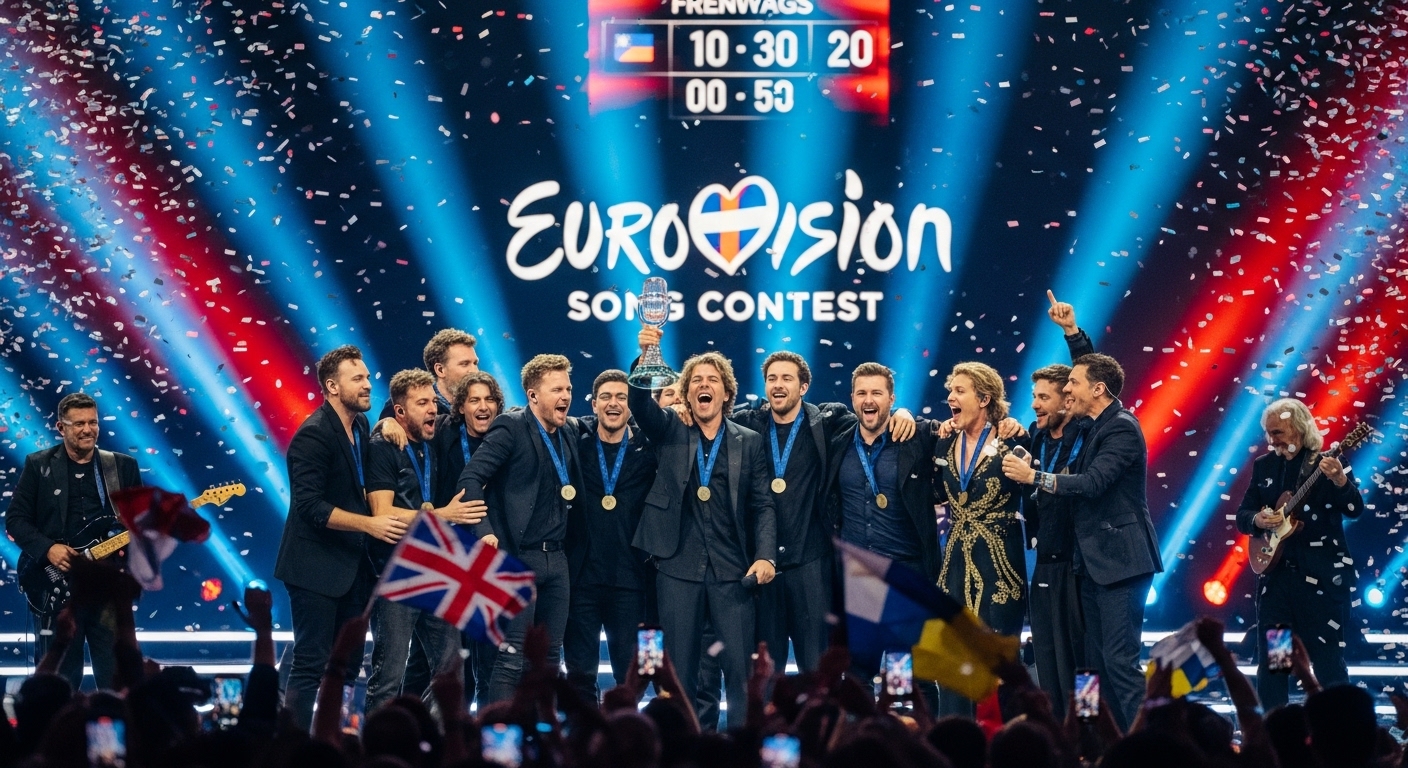
Eurovision 2026 is already making history before a single note is sung. The 70th edition of the world's biggest live music event lands in Vienna, Austria this May and it's shaping up to be the most talked-about, streamed, and TikTok'd contest ever. But who's really driving that conversation? Spoiler: it's not just the broadcasters.
Welcome to the age of the Eurovision influencer. From YouTube creators whose reaction videos clock millions of views, to the artists arriving in Vienna with pre-built global fanbases, influence in 2026 is reshaping how Eurovision works from the voting booth to the green room.
How Social Media Took Over Eurovision
Eurovision didn't discover social media. Social media kits discovered Eurovision and then completely moved in.
For years, the contest was a shared TV moment. You watched with your family, argued about the voting, and forgot about it until next May. That world is gone. Today, a Eurovision entry can go viral on TikTok before it's even performed live. A rehearsal clip can shift betting odds overnight. A creator with half a million subscribers can genuinely move the needle on which song gets twelve points from a nation they've never visited.
In 2026, social media promotion isn't optional for Eurovision artists it's essential. Here's how the major platforms are being used:
- TikTok drives discovery, especially among younger audiences who first encounter entries through 30-second clips rather than national broadcast shows.
- Instagram gives fans a direct, ongoing connection to artists throughout the competition season behind-the-scenes content, rehearsal updates, and personal stories.
- YouTube hosts the long-form breakdowns, reaction videos, and deep dives that turn casual viewers into devoted fans.
- Reddit and fan forums are where the real tactical conversations happen entry analysis, voting predictions, and staging critiques that sometimes feel more insightful than any professional commentary.
The result? Eurovision is no longer a two-week event. It's a year-round conversation, and influencers are the ones keeping it alive between Mays.
The Artists Who Arrived as Influencers
This year's contestant list includes artists who had already built significant digital audiences before they stepped into a national selection. That's a shift worth paying attention to.
Finland Linda Lampenius & Pete Parkkonen ("Liekinheitin")
Finland is the runaway favourite to win Eurovision 2026, and social media presence is part of why. Linda Lampenius a world-class classical violinist who toured internationally under the stage name Linda Brava before she turned twenty came into Eurovision with an established global following. Paired with pop singer Pete Parkkonen, their entry "Liekinheitin" (Finnish for "flamethrower") fuses operatic violin with electrifying pop production.
Their staging, directed by Sergio Jaen, has generated major buzz across fan platforms. Betting markets currently give Finland a winning probability exceeding 40% the highest of any act. Their pre-existing influence didn't just help them qualify. It made them favourites before the rehearsals started.
Latvia Atvara ("Ēnā")
Atvara is one of Eurovision 2026's most compelling stories. She's a singer-songwriter who won Latvia's national selection, Supernova 2026, with the song "Ēnā" but she didn't build her platform after winning. She brought it with her. Her single "Pie manis tveries" had already been viewed over 2 million times on TikTok and was featured in a Latvian TV series before she ever competed for Eurovision. That's the new model influencer first, contestant second.
Australia Delta Goodrem ("Eclipse")
When Delta Goodrem was announced as Australia's representative, betting markets immediately moved Australia into their top three for the first time since 2016. Her song "Eclipse" charted in Australia before the contest had even begun. That surge wasn't purely about the music it was about who Goodrem already was to millions of people. Pre-existing influence did the work before the stage had a chance to.
Eurovision's Own Influence Machine
It's worth noting that Eurovision itself has become an incredibly effective digital operator.
- The official Eurovision TikTok has 3.7 million followers and over 180.7 million likes.
- The official Instagram sits at 2 million followers with consistent, high-engagement content throughout the season.
- The official Eurovision app offers exclusive content, in-app voting, and real-time updates during live shows.
For Vienna specifically, the city's ivie app has been repurposed as the official host city app letting fans explore contest locations, find fan zones, and join a citywide Eurovision treasure hunt with quiz questions and prizes. It's a genuinely clever use of existing infrastructure that makes the city itself feel interactive for the hundreds of thousands of visitors arriving in May.
The Voting Changes That Actually Matter
The EBU has made significant structural changes to how Eurovision 2026 is voted on and most coverage has undersold just how meaningful these reforms are.
Here's what's changed for 2026:
- Votes per person halved - The maximum number of votes per payment method (online, SMS, phone) has been cut from 20 to 10, explicitly to encourage fans to spread support across multiple entries rather than block-voting a single act.
- Juries return to Semi-Finals - Professional juries are back in the semi-finals for the first time since 2022, creating a roughly 50/50 split between audience and jury votes at that stage.
- Bigger, more diverse jury panels - Jury size increases from 5 to 7 members. Eligible professions now include music journalists, critics, teachers, choreographers, stage directors, and industry figures. Young jurors aged 18–25 are explicitly included for the first time.
- Anti-fraud safeguards - Enhanced technical measures to detect and block coordinated or fraudulent voting activity have been introduced.
- Limits on external promotion - Stronger rules curb what the EBU calls "disproportionate third-party influence, including government-backed campaigns."
These changes came after an independent review commissioned by the EBU's Executive Board following the 2025 contest. They represent a direct response to the conversation that fans and influencers have been having publicly for years about fairness in Eurovision voting. The community pushed. The institution listened.
Fan Tools Driving Real Innovation
Here's something mainstream coverage consistently ignores: the grassroots innovation happening around Eurovision is extraordinary, and fan-built tools are a huge part of it.
Eurovision Vote Party allows fans to create personal scorecards or group voting events with live-updating results. Councils and community organisations have used it to host official Eurovision viewing events one Birmingham city centre event had around 300 people participating through the platform alone. There's even a one-click social share feature so you can post your rankings like a Eurovision version of Wordle.
Dedicated fan sites like AussiVision run annual public polls using a televote-style format. In 2025, over 246,000 people voted in their Eurovision poll. That's not a niche hobby project. That's a media property with real reach.
Then there are the YouTube channels and podcasters producing episode-length breakdowns of national selections, staging analyses, and historical voting pattern studies. For many younger fans, these creators are more trusted and more informative than any national broadcaster.
The Boycott, the Geopolitics, and Why Influencers Are Central to Both
No honest conversation about Eurovision 2026 is complete without addressing the boycott. Five countries Iceland, Ireland, the Netherlands, Slovenia, and Spain have withdrawn from this year's contest in protest over Israel's continued inclusion amid the ongoing conflict in Gaza. This is the largest boycott since 1970.
Much of the campaign driving this response has been amplified, and in some cases initiated, on social media. Viral posts from activists, musicians, and content creators shaped public opinion in a way that no formal statement could. Fan communities mobilised around hashtags. Journalists and creators made the case directly to young audiences who consume news through platforms, not through TV bulletins.
Whether you support the boycott or oppose it, this is influencer power operating at a structural level. Five national broadcasters changing their position at least partly in response to online public pressure is not a small thing. Eurovision has always been about soft power. In 2026, that power runs through social media first.
What the 70th Anniversary Looks Like On Stage

Vienna is fully committed to making this feel like a milestone worth remembering.
The interval acts alone read like a curated greatest-hits tour of Eurovision's own cultural influence:
- Lordi (Finland 2006 winners)
- Verka Serduchka (Ukraine 2007)
- Il Volo (Italy 2015)
- Erika Vikman (Finland 2025)
All four are returning to perform new versions of their iconic entries. JJ the 2025 winner who brought the contest back to Vienna will perform a brand-new song, "The Queen of the Night," backed by the Vienna Radio Symphony Orchestra, dancers, and acrobats at the Grand Final opening.
The stage design is built around three leitmotifs inspired by the Viennese Secession:
- The Leaf - a symbol of origin and new beginnings
- The Curved Line - representing resonance, movement, and Viennese charm
- The Construct - a golden structure connecting art with functionality
The Green Room connects directly to the main stage via a walkway, enabling the Winner's Walk through the audience. Every one of these elements is designed to create shareable visual moments which in 2026 means they're designed with social media in mind, whether the producers explicitly say so or not.
Where Eurovision Innovation Still Has a Long Way to Go
Vienna is doing a lot right. But let's be honest about the gaps.
Real-time language accessibility is still missing. Every lyric should be displayable in a viewer's native language in real time not just English subtitles, but live localisation across dozens of languages. The technology exists. Eurovision hasn't deployed it. For a contest that calls itself "United by Music," that's a strange blind spot.
Fan content and copyright remain a persistent tension. Fan edit videos get copyright strikes on YouTube. Reaction channels walk a constant legal tightrope. The official content ecosystem hasn't found a way to embrace fan creativity rather than compete with it and in an era when fan content drives discovery among younger audiences, this costs the contest real growth.
The Rest of the World vote is a welcome innovation but still carries only the weight of a single participating country. In a contest that drew over 160 million viewers worldwide in 2025, giving the entire global audience a combined vote worth the same as Malta doesn't fully reflect where Eurovision's cultural reach actually lives.
These aren't small complaints. They're the next frontier and the influencers, fans, and creators who love this contest will keep pushing on them until they're addressed.
FAQs
What is the Eurovision Song Contest 2026?
It's the 70th edition of the annual Eurovision Song Contest, held in Vienna, Austria. Two semi-finals take place on May 12 and 14, with the Grand Final on May 16 at the Wiener Stadthalle.
Who won Eurovision 2025?
Austria's JJ won with "Wasted Love" in Basel, Switzerland bringing the contest back to Vienna for the third time in Austrian history.
Who are the favourites to win Eurovision 2026?
Finland (Linda Lampenius & Pete Parkkonen) leads with over 40% implied probability. France's Monroe is second, Denmark third, with Australia's Delta Goodrem a notable wildcard.
How has voting changed for 2026?
Votes per person are halved (20 to 10), professional juries are back in the semi-finals, jury panels are larger and more diverse, and anti-fraud safeguards have been strengthened.
Which countries are boycotting Eurovision 2026?
Iceland, Ireland, the Netherlands, Slovenia, and Spain all withdrawing in protest over Israel's participation amid the ongoing Gaza conflict.
Can people outside Europe vote?
Yes. The "Rest of the World" online vote, introduced in 2023, lets fans from non-participating countries vote across all three live shows, with their combined total weighted as one participating country.
How do influencers actually affect Eurovision?
They build pre-existing fanbases that translate into televotes, create viral content that drives entry discovery, run fan polls that shape public perception, and amplify geopolitical debates that affect broadcast decisions.
What app should I use for Eurovision 2026?
The official Eurovision app for content, voting, and live updates. Fans visiting Vienna should also download ivie, the official host city app, which includes a citywide Eurovision treasure hunt and event guide.
Final Thought
Eurovision 2026 is more than a song contest it's a living, breathing case study in how music, culture, and digital influence intersect in real time. The artists, the fans, the creators, and even the protesters are all part of one enormous, beautifully chaotic conversation that plays out across stages, screens, and smartphones simultaneously. Vienna provides the backdrop. But the real show? It's already happening everywhere else.