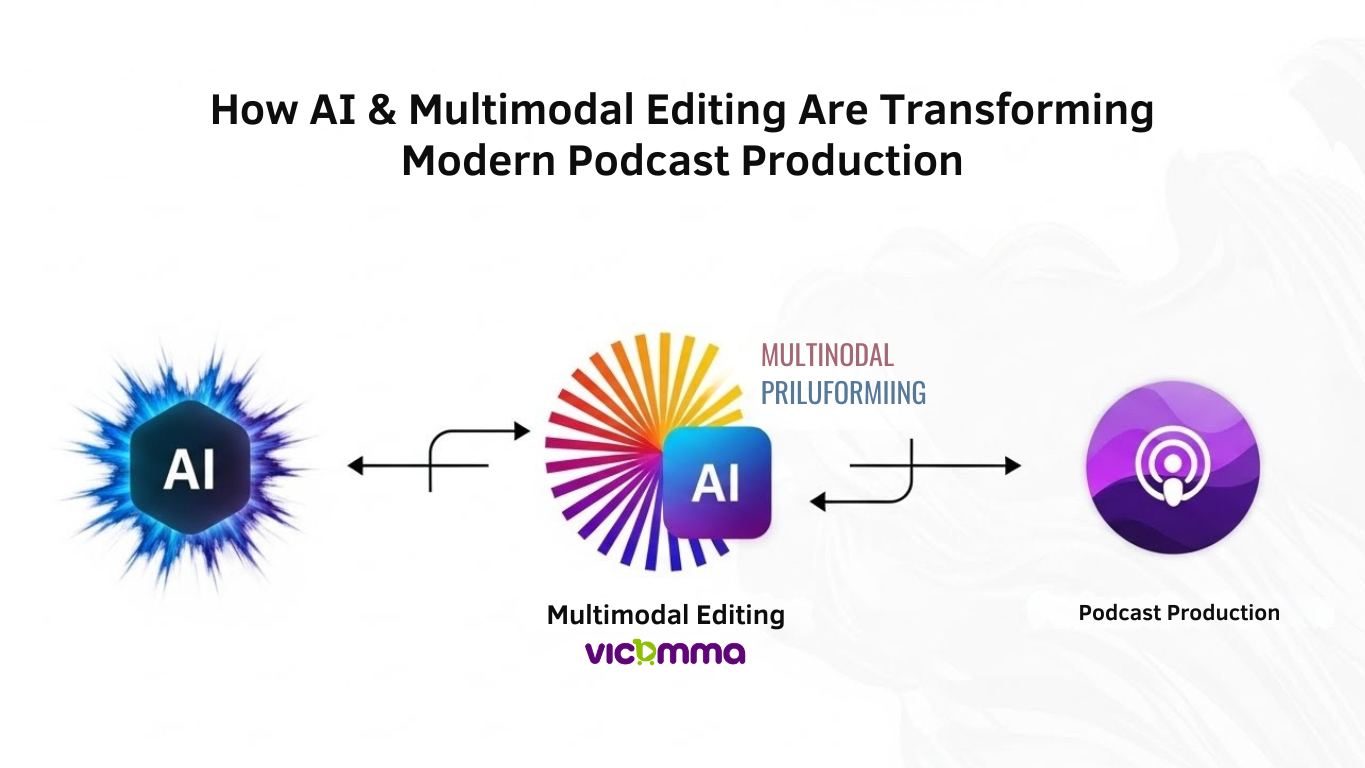
Podcasting has quietly entered its next era an era defined not just by microphones and storytelling, but by advanced AI systems, spatial audio engines, and multimodal editing tools that radically reshape how creators produce, refine, and publish their shows.
With more than 5 million podcasts globally and billions of monthly listeners, the demand for cleaner audio, polished mixing, and production consistency has exploded. But unlike the early days of podcasting, the solution is no longer just “better equipment.”
The real revolution is happening inside the software, where next-generation tools are making production smarter, faster, and more collaborative than ever.
In this blog, we explore the latest technology trends reshaping the future of audio storytelling and why creators and brands are paying attention.
Multimodal Editing From Manual Cuts to Intelligent Workflows
Traditional audio editing required laborious waveform manipulation. Today, multimodal editing tools turn audio, text, and video into a unified editing experience.
What does that look like
-
You edit words on a transcript and the audio automatically updates.
-
Filler words, long pauses, and repeated phrases can be removed in a single click.
-
AI can detect different speakers, emotions, and segments to auto-organize the episode.
Tools like Adobe Podcast and Descript are pushing this boundary, creating workflows that resemble advanced word processors more than audio software.
Why it matters for creators
Creators without technical expertise can now produce near-studio-quality results.
Brands can maintain consistent voice identity across multiple episodes.
Editors can focus on creative decisions rather than manual cleanup.
AI-Driven Noise Repair & Voice Enhancement
In 2026, AI audio processing models have surpassed traditional noise gates and compressors.
We now have:
-
Deep-learning hum and buzz removal
-
Room tone reconstruction
-
AI-powered de-reverb
-
Ultra-clean voice enhancement that preserves vocal texture
These tools are trained on thousands of environments coffee shops, offices, traffic conditions meaning they understand the difference between noise and human voice at a microscopic level.
Even if a creator records with a basic USB mic, advanced AI can transform it into broadcast-ready quality.
Spatial Audio & Immersive Soundscapes Are Going Mainstream
Platforms like Apple creators, Spotify creators, and youtube creators are integrating spatial audio experiences.
Podcasters are using:
-
Binaural sound fields
-
Dynamic stereo panning
-
Ambient environment layers
The result? A listener feels inside the conversation.
Imagine:
-
A true-crime podcast placing footsteps behind you
-
A business interview with crisp, separated speaker positioning
-
A storytelling show using atmospheric surround elements
Immersive sound used to require Hollywood-level equipment.
Now it’s becoming accessible through cloud tools and AI plugins.
Real-Time Editing Pipelines: The Future of Remote Collaboration
Remote recording used to produce inconsistent quality because each participant used different gear.
New technology solves this by using real-time cloud processing, including:
-
Live background noise detection
-
Latency correction
-
Auto-leveling during the call
-
Cloud backups of raw multi-track audio
This ensures every guest sounds like they’re in the same studio even if they’re continents apart.
As more brands edit podcasts for thought reels videos leadership, product education, or storytelling campaigns, real-time pipelines make production dramatically smoother.
Human Expertise Still Matters Especially in the AI Era
Despite AI’s rapid advancement, human creative direction remains crucial.
Why?
Because:
-
Machines can’t replicate storytelling instinct.
-
Editors understand pacing, tone, emotion, and narrative flow.
-
Strategic cuts require human judgment.
-
Brand-aligned sound design requires creative experience.
This is why many creators and businesses are now combining AI tools with find experienced audio professionals to get the best results.
If you’re planning to scale your content, release consistent episodes, or create branded audio experiences, working with skilled editors becomes essential.
Predictive Audio Engines & Auto Generated Episodes

The next wave of innovation is already taking shape:
Predictive audio editing
Software will predict which parts of audio should be trimmed based on pacing analytics.
Emotion-matched sound design
AI will automatically select background music based on the speaker’s tone and energy.
AI “first-pass edits”
Creators will receive a near-final episode instantly, with editors focusing only on refinement.
Multi-language voice cloning
Podcasters will distribute episodes in multiple languages using cloned versions of their own voice.
These advancements point to a future where content creation becomes multi-lingual, hyper-efficient, and globally scalable.