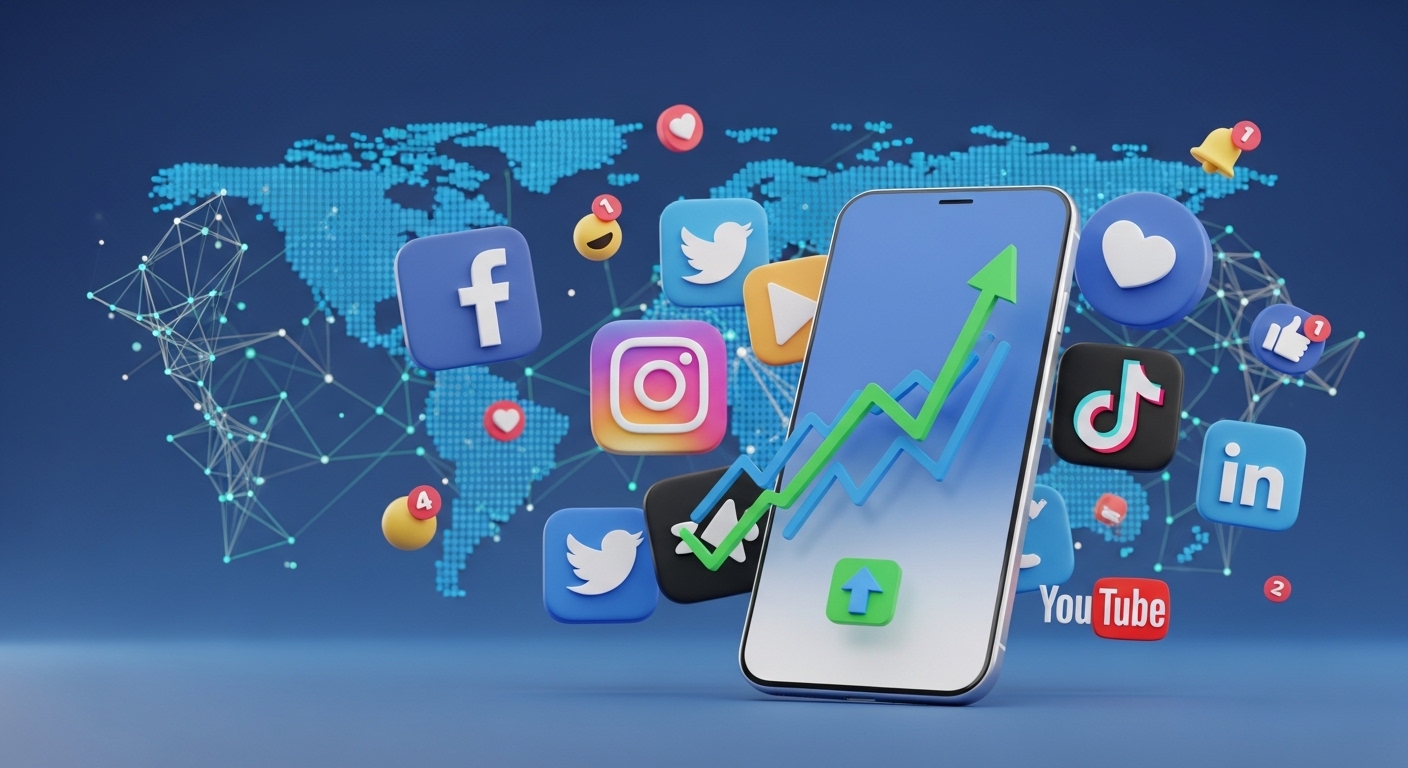
In 2026, social media growth runs on artificial intelligence, real-time data, and automation that works around the clock, even when your team is offline. Brands that understand this are pulling ahead fast. Those that don't are wondering why their engagement keeps dropping.
This post gives you a full breakdown of what's actually happening at the intersection of AI, data, and social media, and what it means for your growth strategy right now.
We also read the top competitor articles on this topic and added everything they missed, including two brand-new strategies you won't find covered anywhere else.
The Big Picture: Why 2026 Is a Real Turning Point
Let's be honest. "AI is changing everything" gets said so often it sounds like background noise now.
But 2026 is genuinely different.
The tools have matured. The results are measurable. And the gap between brands using AI and those that aren't is no longer a small one. It's massive.
Social media platforms are now AI-first environments. TikTok, Instagram, LinkedIn, and YouTube run on machine learning algorithms so advanced that what a user sees is shaped almost entirely by behavioral signals, not just by who they follow.
That completely changes the rules of organic reach.
You're not just competing with other brands for attention. You're competing with an algorithm that holds billions of data points on every single user.
The brands winning on social media in 2026 share a few things in common:
- They use AI to work with platform algorithms, not against them.
- They replace guesswork with real-time data at every stage.
- They automate repetitive work so their teams can focus on strategy.
- They treat social media as a full business growth engine, not just a content calendar.
This is the new baseline. Everything below shows you how it works in practice.
AI-Power Content Creation
Content is still king. But the throne room looks very different in 2026.
AI tools like Jasper, Blaze, and platform-native assistants can now analyze your existing content, your competitors' top posts, current trending topics, and your audience's recent behavior.
Then they generate ideas and full drafts in seconds.
These tools are trained on your brand's voice, tone, and style. So the output actually sounds like you, not like a robot trying to sound like you.
Short-form video is the biggest content challenge right now. Creating enough of it used to need a full production team. Today it doesn't.
Here's what AI video tools can now do on their own:
- Slice one long video into dozens of optimized short clips.
- Add accurate captions and choose the best thumbnail frames.
- Suggest hook structures most likely to keep viewers watching past three seconds.
- Turn a product URL into a finished professional video, no camera needed.
One person with the right AI tools can now produce what used to take a team of five. And quality stays consistent because the AI keeps learning from performance data over time.
Predictive Analytics: Knowing What Your Audience Wants
This is where social media strategy gets really exciting.
Predictive analytics uses historical data, behavioral signals, and machine learning to forecast what your audience will respond to before you've even posted anything.
It's like having a crystal ball. Except it runs on millions of real data points.
In practical terms, a brand can now:
- Predict which content formats will get the highest engagement next week.
- Identify which products are trending in their audience segment right now.
- Spot customers who are likely to stop engaging before they actually do.
- Detect "micro-viral" moments in social conversations hours before they peak.
That last one is something most competitors rarely mention.
Small spikes in social conversation often predict a much bigger wave of interest days before it hits the mainstream. Brands that catch these signals early and act fast consistently get ahead of the competition before they even notice what's happening.
The budget impact is just as significant. Instead of spreading ad spend evenly and hoping something lands, predictive models show you exactly where to put your money for the highest likely return.
Less waste. Better results. Every single time.
Automation and Scheduling: The Engine Running Quietly
Anyone who has managed social accounts knows the exhaustion of the daily posting treadmill.
Every day, every platform, every time zone, every format. It never stops.
AI-powered automation has turned that grind into something far more manageable.
Tools like Buffer, Hootsuite, and Sprout Social now use behavioral data to recommend the exact times each audience segment is most active. Not generic advice. Account-specific recommendations that update automatically as your audience shifts.
But scheduling is just the beginning. Modern automation handles a lot more:
- Testing multiple content variations against each other at the same time.
- Reposting high-performing user-generated content without manual input.
- Sending context-aware smart replies to comments automatically.
- Reallocating ad budgets in real time based on live performance data.
- Keeping social campaigns in sync with email, CRM, and paid search workflows.
Content repurposing is worth a special mention here.
A single blog post can automatically become a tweet series, a LinkedIn article, Instagram carousel frames, and a short video script. Each one formatted for the platform it's going to.
This isn't just convenient. It's a completely different content model that lets smaller teams compete with much bigger ones.
Hyper-Personalization: Talking to One Million People
Generic content doesn't just underperform in 2026.
It actively damages your brand.
Audiences have been trained by algorithmic feeds to expect content that feels personally relevant to them. When it doesn't, they scroll without a second thought.
AI makes hyper-personalization possible at scale. It analyzes browsing behavior, purchase history, and content interaction patterns for every individual user.
Using that data, brands can serve completely different versions of the same campaign to different audience segments. And it all happens automatically, without building each variation by hand.
Brands seeing three and four times better returns on social ad spend in 2026 aren't spending more money. They're targeting smarter.
The best part? This level of targeting used to need a dedicated data science team. Now it's built into most major AI advertising platforms at a price any brand can access.
AI Chatbots and DM Sell Your Inbox Is Now a Revenue Channel
This one catches a lot of brands completely off guard.
Direct messages used to be a customer service burden. The place where complaints piled up and your team had to answer them one by one.
In 2026, DMs have become one of the highest-converting sales channels on the internet.
AI-powered chatbots on Instagram, WhatsApp, Messenger, and TikTok can now handle a full customer journey:
- Answer complex queries around the clock without any human input.
- Qualify leads based on what's said in the conversation.
- Recommend products based on a customer's past purchase history.
- Guide users from product discovery all the way through to checkout inside the app.
- Pass sensitive issues to a human team member with full conversation context already attached.
Around 88% of consumers have had at least one chatbot conversation in the past year.
AI bots can cut response times by up to 80%. More importantly, they increase conversions because they respond instantly, at any hour, with personalized messaging that email sequences simply can't match.
The most forward-thinking brands have turned DMs into complete social commerce funnels. A user sees a video, taps to message the brand, and the AI handles everything through to checkout. No app switching. No friction. No drop-off.
That seamless path from interest to purchase is completely redefining what conversion means in 2026.
Sentiment Analysis and Crisis Management
One of the most underrated uses of AI in social media is sentiment analysis.
It means automatically tracking what people say about your brand, your competitors, and your industry, and understanding the emotional tone behind every conversation.
Tools like Sprout Social's sentiment engine scan millions of posts, comments, and mentions in real time. They flag shifts in mood before things have a chance to escalate.
A spike in negative sentiment around a product launch can be caught and handled in hours, not days.
But here's what most competitors don't cover at all: AI's role in active crisis management.
When something goes wrong, a campaign lands badly, a complaint starts spreading, or a public figure mentions your brand in the wrong way, AI systems can step in immediately:
- Detect the sentiment spike the moment it starts.
- Categorize the type of complaints automatically.
- Pull up pre-approved response templates that match the situation.
- Alert the right team members with full context before anything gets bigger.
In a world where a single post can go from 200 views to 2 million in under four hours, the difference between AI monitoring and manual monitoring is everything.
Brands with these systems resolve issues faster and walk away with far less lasting damage to their reputation.
Influencer Marketing and AI: Finding the Right Voices

Influencer marketing has always had a dirty secret.
Follower counts are easy to inflate. Reach doesn't equal impact.
A lot of brands have burned big budgets on partnerships that looked great in a presentation and delivered almost nothing in real results.
AI is cleaning this up fast.
AI-powered discovery tools now analyze engagement quality, not raw numbers. They look at what actually matters:
- Whether comments are genuine or bot-generated.
- How follower-to-engagement ratios have trended over time.
- How well an influencer's audience overlaps with your actual target customer.
- How similar campaigns performed historically for comparable brands.
An influencer with 50,000 highly engaged niche followers will consistently outperform a celebrity with 2 million passive ones.
AI surfaces these smaller creators reliably. What used to take weeks of manual research now takes minutes.
Beyond discovery, AI also tracks campaign performance in real time. It connects influencer activity directly to traffic, conversions, and revenue, not just reach and impressions.
For the first time, influencer ROI is genuinely measurable. That holds both brands and creators accountable for real business results, not vanity metrics.
Search Everywhere Optimisation and GEO
This is one of the biggest shifts happening in 2026, and most brands are still sleeping on it completely.
It's also almost entirely absent from every major competitor article we reviewed on this topic.
Social media and search have merged. This isn't a coming trend. It has already happened.
Research from HubSpot confirms that 84% of marketers now say consumers search for brands on social platforms rather than traditional search engines.
For younger audiences, TikTok and Instagram have replaced Google as the first stop for product discovery and purchase research. TikTok's search bar processes billions of queries every single month.
What this means for your social strategy is very practical:
- Use real keywords in captions and video scripts, not just hashtags.
- Write on-screen text that matches what people actually type when they search.
- Structure your videos so AI can identify the topic within the first three seconds.
- Answer the specific questions your audience is already searching for on these platforms.
- Treat every post as a searchable piece of content, not just a feed item.
The second half of this strategy is called Generative Engine Optimisation, or GEO.
As more people use AI assistants like ChatGPT, Google's AI Overviews, and Perplexity to get answers, a new question has come up. Is your brand being recommended by these tools?
GEO means structuring your content so AI assistants cite your brand as a trusted answer. The brands winning at GEO publish authoritative content consistently, maintain strong entity signals online, and get mentioned by credible sources across the web.
Neil Patel Digital forecasts a 30 to 40% decline in traditional organic traffic by end of 2026 for brands that ignore this shift. That number alone should get your attention moving.
The Lore Economy and Brand Universe Building
This is the second major strategy that every competitor article on this topic misses completely.
And it may be the most creatively exciting shift happening on social media right now.
There's a quiet backlash building against AI-generated content. Platforms are filling up with fast, polished, and technically correct posts that feel completely emotionally flat. Audiences have developed a sharp sense for content that was made to be efficient rather than made to connect.
When they sense it, they scroll straight past.
This creates a real paradox. You need AI to keep up with the volume these platforms demand. But audiences want to feel a genuine human connection at the same time.
The answer that smart brands are discovering is something researchers call the Lore Economy.
Instead of posting one-off campaigns, the most engaging brands in 2026 are building what feel like small cinematic universes. Cohesive brand worlds with recurring themes, inside references, evolving storylines, and a narrative that rewards long-term followers for paying close attention.
Think about how fans talk about their favorite shows or game franchises:
- They follow the whole universe, not just individual pieces.
- They notice callbacks and discuss what they mean.
- They feel like insiders, and that feeling turns them into loyal advocates.
AI plays a critical role in making this scalable. Rather than generating the lore itself, which still needs real human creativity, AI analyzes your entire content archive. It finds which themes, phrases, and visual styles have connected most deeply with your audience over time.
It also flags when new content contradicts your established brand narrative, and suggests smart references to past content that reward loyal followers while staying accessible to newcomers.
Hootsuite's 2026 research adds another layer to this, which they call Creative Disruption.
The brands getting the most organic reach right now aren't always posting the most polished content. They're occasionally publishing something so unexpected that it stops people mid-scroll and starts a real conversation.
AI can help brainstorm exactly those kinds of bold ideas, the ones a cautious human team might normally talk themselves out of posting.
Treat your brand like a franchise, not just an advertiser. Give it history, consistent characters, and an ongoing story. Use AI to keep it all coherent as you scale.
Agentic AI: The 24/7 Autonomous Workforce
Most brands are still using AI as a writing assistant.
The brands gaining the biggest edge in 2026 are using it as an autonomous agent that actually gets things done on its own.
There's a real and important difference here.
Regular AI tools respond when you prompt them. You ask for a caption, they write one. Agentic AI takes action within boundaries you set in advance and executes multi-step workflows without waiting for a human at every stage.
A social media AI agent in 2026 doesn't just draft content. Without anyone asking it to, it can:
- Monitor activity across all your platforms at the same time.
- Detect a performance spike and boost the post within a pre-approved budget automatically.
- Adjust the next two days of your schedule based on live audience behavior.
- Route a customer complaint to the right team member with the full conversation context already attached.
- Log every action it takes with a complete audit trail for you to review later.
For enterprise brands managing multiple product lines, markets, and languages, this kind of execution is genuinely transformative.
But even small businesses benefit. Setting up AI agents for just one or two workflows, like scheduling or engagement routing, can reclaim meaningful hours every single week.
The key is proper guardrails. Clear approval thresholds, human escalation paths for anything sensitive, and regular audits of autonomous actions. Without those guardrails, automation creates chaos. With them, it becomes a measurable competitive advantage.
Data Privacy and Ethics: Growing Responsibly in an AI-First World
All this talk of data collection and personalization comes with a responsibility that brands simply can't ignore.
Audiences in 2026 are more privacy-aware than ever. Regulatory pressure in major markets has pushed brands to rethink how they collect and use social data.
The shift toward zero-party data is picking up real speed. This is information that users actively and voluntarily share with brands, not data pulled from passive behavioral tracking.
Interactive polls, preference quizzes, and direct feedback tools are becoming core strategies. Not just because they're ethically cleaner, but because the data quality is genuinely better.
Every brand should have these basics in place:
- Be upfront with your audience about how their data gets used.
- Build human review into every AI-driven workflow before it goes live.
- Set clear approval checkpoints for AI-generated content before it publishes.
- Keep humans in the loop for any decision that needs real judgment, like crisis responses or community moderation.
Brands that handle this well consistently build higher levels of trust with their audiences.
And in 2026, trust is the most durable foundation for long-term growth.
The Human-AI Balance: Why You're More Important Than Ever
Here's the thing nobody tells you while they're selling you AI tools.
The technology is only as good as the people running it.
AI can generate content. But it doesn't understand what your brand actually stands for. It can read sentiment data. But it can't feel empathy. It can optimize for engagement. But it can't make the big creative decisions that define a brand's identity.
The marketers winning in 2026 aren't the ones who've handed everything over to automation.
They're the ones who use AI to amplify their own thinking and creativity, not replace it.
The day-to-day role has shifted in a meaningful way:
- Less time on repetitive execution, more time on strategy and storytelling.
- Less time pulling data manually, more time deciding what that data actually means.
- Less time building content from scratch, more time guiding AI in the right creative direction.
- Less time managing platforms one by one, more time building real community relationships.
The creative, empathetic, contextually aware things that humans do naturally are more valuable than ever in a world where AI handles the mechanical work.
AI gives you leverage. But you have to show up and use it well.
FAQs
Q: Do I need a big budget to start using AI for social media in 2026?
Not at all. Many solid AI tools start between five and fifteen dollars a month. Start with one clear pain point, like scheduling or content ideas, rather than trying to automate everything at once. Tools like Buffer, Flick, and SocialChamp offer real capabilities at prices that work for small businesses and individual creators.
Q: Will AI eventually replace social media managers?
No, but the role is genuinely changing. AI handles repetitive and data-heavy tasks well. What it can't do is build real community, read cultural nuance, or make the kind of creative calls that give a brand its personality. Social media managers who learn to work alongside AI will be far more valuable, not less.
Q: What is Generative Engine Optimisation and do I actually need it?
GEO is the practice of structuring your content so AI assistants like ChatGPT and Google's AI Overviews recommend your brand as a trusted answer. Traditional SEO gets you ranked on Google. GEO gets you recommended by AI. Start by publishing genuinely helpful content that directly answers the specific questions your audience is already asking.
Q: What is the Lore Economy and does it apply to small brands?
The Lore Economy means building a consistent brand narrative universe rather than posting disconnected content. Recurring themes, inside references, and ongoing storylines that reward loyal followers. It absolutely applies to small brands. You don't need a big production budget. You need a consistent point of view and the patience to let a real community grow around it.
Q: What is Agentic AI and how is it different from regular AI tools?
Regular AI responds when you ask it to. Agentic AI takes action on its own within boundaries you set in advance. It monitors your channels, detects an opportunity or a problem, and acts on it without waiting for a prompt. In 2026 it's being used to auto-boost high-performing posts, route customer messages, adjust schedules in real time, and flag brand risks early.
Q: How do I choose the right AI social media tools for my brand?
Start with your biggest pain point. Content bottleneck? Try Jasper or Blaze. Scheduling chaos? Buffer or Hootsuite. Weak analytics? Sprout Social or Amplitude. Most tools offer free trials, so test before you commit and always check that the tool integrates with your existing setup.
Q: Is AI-generated content penalized by social media algorithms?
Not on its own. What platforms care about is quality and relevance. AI content that gets reviewed, refined, and genuinely serves the audience performs just as well as anything written by hand. The problem shows up when AI content goes live without human review and ends up feeling generic or off-brand. Use AI as a strong starting point, never as the final word.
Q: How can small businesses use AI to compete with bigger brands on social media?
AI levels the playing field in a real way. Smaller businesses now have access to predictive analytics, smart scheduling, audience segmentation, and chatbot tools that used to need entire departments to run. A small brand with a clear voice and a well-configured AI stack can absolutely outperform a large corporate account that's still doing things the slow and manual way.
Final Thoughts
Social media in 2026 rewards brands that move smart, not just fast. AI, data, and automation have taken the guesswork out of growth, but only for the teams willing to actually learn and apply them. Pick the one area where your current strategy feels weakest, apply the right tool to it, watch what changes, and build from there. That's the whole playbook.