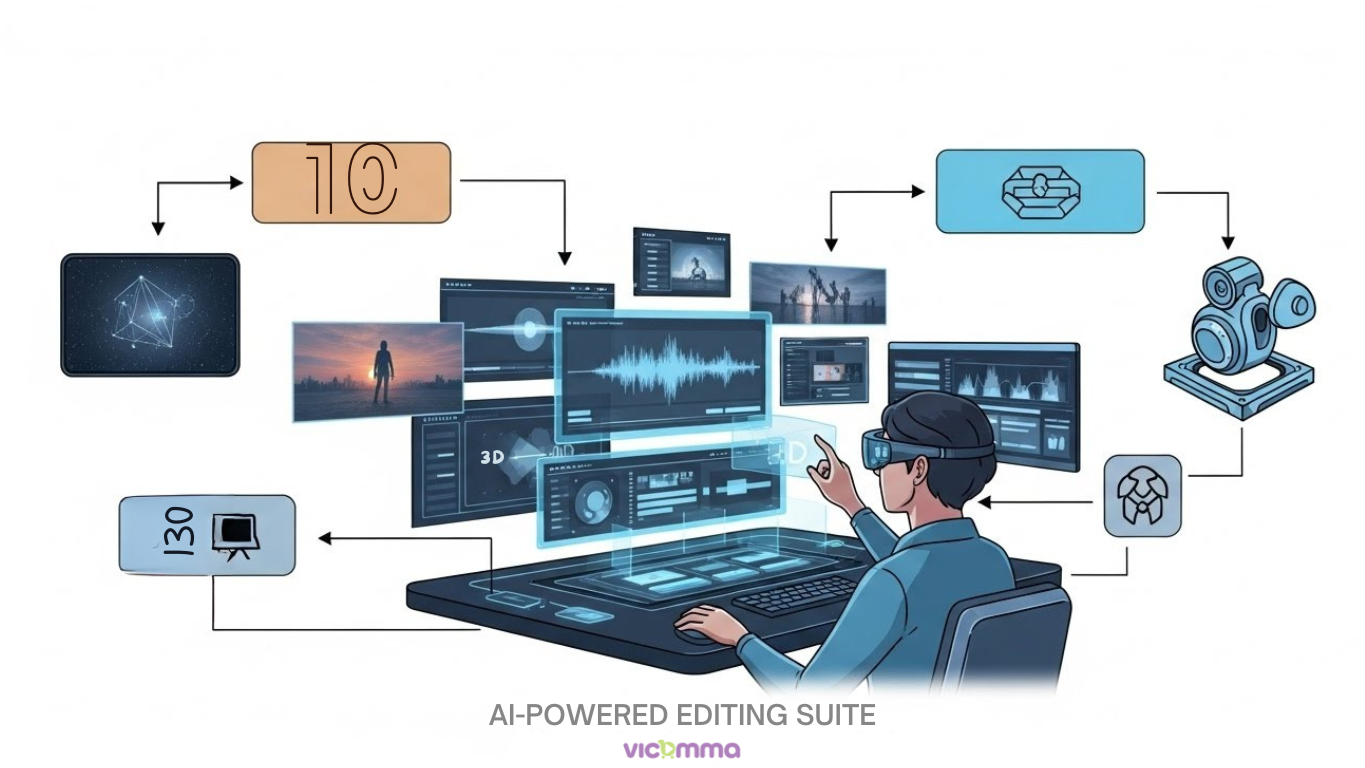
Do you remember the first time a music video really made you feel something, Maybe it was the cinematic thrill of Michael Jackson’s Thriller or the colorful, chaotic genius of early MTV. For decades, the "music visual story" has been a flat experience: you sit back, you watch, and you listen. But as we race toward 2026, that passive relationship is about to shatter. We are standing on the edge of a revolution where you won't just watch the story of a song you will step inside it.
The music industry is colliding with advanced entertainment technology at a speed we haven't seen since the invention of the MP3. Come in 2026, the convergence of Artificial Intelligence (AI), Volumetric Video, and Extended Reality (XR) will turn albums into living, breathing worlds. This isn’t just about better graphics; it is about a fundamental shift in storytelling. Artists are no longer just singers; they are world-builders, and you are no longer just a fan you are a main character.
| Section Heading: | The Old Way (2024 & Prior): | The 2026 Transformation: |
| The End of Flat Video | 2D Music Videos on YouTube | Volumetric 6DoF (Six Degrees of Freedom) experiences. |
| Hyper-Personalization | One official video for everyone | AI-tailored visuals that adapt to your mood and choices. |
| The Infinite Concert | Expensive physical tickets | Hybrid Reality gigs bridging physical venues and digital twins. |
| Fan as Creator | Passive viewing | "Official" fan-generated visual canon using artist-approved AI tools. |
The Death of the 2D Screen and the Rise of Volumetric Storytelling
We have spent the last forty years staring at rectangles. Whether it is a TV, a phone, or a cinema screen, music visual storytelling has been trapped in two dimensions. In 2026, the concept of a "frame" will begin to dissolve thanks to the mainstream adoption of volumetric video.
Volumetric video captures an artist in three dimensions, recording every angle, every movement, and every texture. Unlike a standard video that goes black if you turn your phone sideways, volumetric content exists in space. Imagine putting on a lightweight pair of mixed-reality glasses and seeing your favorite singer performing their new ballad right in your living room. They aren't a flat hologram; they are a digital presence you can walk around. You can look at the guitar technique from inches away or stand behind the drummer. The "story" of the song is no longer a movie you watch; it is a moment you share space with. This technology allows for emotional intimacy that flat screens simply cannot convey. When a singer looks you in the eye in a volumetric environment, your brain registers it as real contact.
Hyper Personalization When the Video Know How You Feel
For decades, if an artist released a heartbreak anthem, we all saw the same video of rain on a windowpane. But human emotion is complex, and in 2026, entertainment technology will finally respect that individuality through AI-driven hyper-personalization.
Streaming platforms are currently great at guessing what song you want to hear next, but they are blind to how you want to see it. By 2026, generative AI models will work in real-time to adjust the visual narrative of a song based on your personal context. If you are listening to an upbeat track while running in the morning, your AR glasses might overlay energetic, rhythmic visual pulses that sync with your pace. If you listen to the same track at night while relaxing, the visuals might shift to a calming, neon-noir aesthetic. The artist provides the core "assets" the characters, the themes, the vibe but the AI acts as a live director, editing the visual story to match your current reality. This means a single song could have millions of visual variations, each one unique to the listener.
The Gamification of Music Albums as Playable Worlds
The line between a "video game" and a "music album" has been blurring for years, but in 2026, it will vanish completely. We have already seen massive concerts in games like Fortnite, but the next step is far more ambitious.
Visual storytelling is moving toward "playable albums." Instead of releasing a list of tracks, an artist might release a digital environment a forest, a cyberpunk city, or a dreamscape that fans explore. As you move through this world, the music changes. You might unlock the next verse of a song by solving a visual puzzle or discover a hidden acoustic track by walking into a virtual cave. This transforms the visual story from a passive linear path into an active treasure hunt. It rewards curiosity. The story isn't just told to you; it is revealed by you. This shift turns casual listeners into explorers, deepening the connection to the lore and lyrics of the artist in a way a standard music video never could.
The Hybrid Stage Concerts That Defy Physics
Live music is the heartbeat of the industry, but it has always been limited by geography and physics. If you couldn't get to London or New York, you missed the show. By 2026, "Immersive Venues" and haptic technology will democratize the live experience without ruining the magic of being there.
Venues like the Sphere in Las Vegas gave us a glimpse of the future, but the 2026 evolution is about "Hybrid Reality" tours. Artists will perform on a physical stage, but the visual story will extend far beyond the venue walls via Augmented Reality (AR) layers accessible to remote audiences. A fan in Tokyo could virtually "step" onto the stage of a concert in Los Angeles. But crucially, 2026 technology aims to solve the "ghost" problem of virtual concerts. Through advanced haptic suits and wearables, remote fans will be able to feel the bass in their chest and the collective roar of the crowd, bridging the sensory gap. The visual story on stage giant floating whales, exploding stars, raining fire will be rendered in real-time 3D, making the visual spectacle identical whether you are in the front row or in your bedroom.
The Fan as Co-Author Democratizing the Visual Canon

Perhaps the most human shift of all is the change in power dynamics. Historically, the artist told the story, and the fan listened. In 2026, fans will be invited to help write the visual history of the music they love.
New user-friendly AI tools will allow fans to remix and reimagine an artist's official visual assets legally and creatively. An artist might release the "source code" of their music video creators
the 3D models of the characters, the lighting rigs, the virtual sets and challenge their fanbase to create the next chapter of the story. The best fan-creations won't just be fan fiction; they will be adopted into the official canon of the album. This creates a community-driven visual mythology. It acknowledges a truth that the music industry has ignored for too long: the fans are the ones who give the music meaning. By giving them the tools to visualize that meaning, artists create a bond that is unbreakable.
FAQs
Will these new technologies make music too expensive for average fans?
This is a valid concern. Initially, hardware like high-end AR glasses will be pricey. However, by 2026, history suggests costs will drop significantly, much like 4K TVs did. Furthermore, many of these experiences will be scalable accessible via a standard smartphone screen for those who don't have headsets, ensuring no fan is left behind.
Does AI mean artists will stop making their own videos?
Not at all. Think of AI as a new camera lens. Artists will still direct the vision and write the stories. AI simply handles the heavy lifting of rendering these massive, complex worlds. It frees artists to be more creative, not less, because they aren't limited by budget or physics.
Will this kill the shared experience of a live concert?
Technology often isolates us, but the 2026 trend is toward connection. Hybrid reality is designed to bring people together. By allowing remote fans to "feel" the crowd and see the same visuals, it expands the community rather than shrinking it. Nothing will ever fully replace the sweat and energy of a mosh pit, but this technology offers the next best thing for the millions who can't be there physically.
Is Volumetric Video just 3D movies?
No. 3D movies are still flat images that use a trick of the eye to look deep. You cannot stand up and walk behind the character in a 3D movie. Volumetric video is true spatial data like a statue made of light. It allows for "Six Degrees of Freedom" (6DoF), meaning you can move forward, backward, up, down, left, and right within the video.
Conclusion
The year 2026 is shaping up to be a renaissance for music lovers. We are moving away from the era of passive consumption and stepping into an era of active immersion. The technologies we have discussed volumetric video, hyper-personalization, and playable worlds are tools that will ultimately bring us closer to the heart of the music.
The "Music Visual Story" is no longer something you watch; it is something you live. It is a shared dream between the artist and the fan, built with light and sound. As we embrace these changes, the most exciting question isn't what the technology can do, but what stories we will tell when the boundaries of the screen finally disappear.