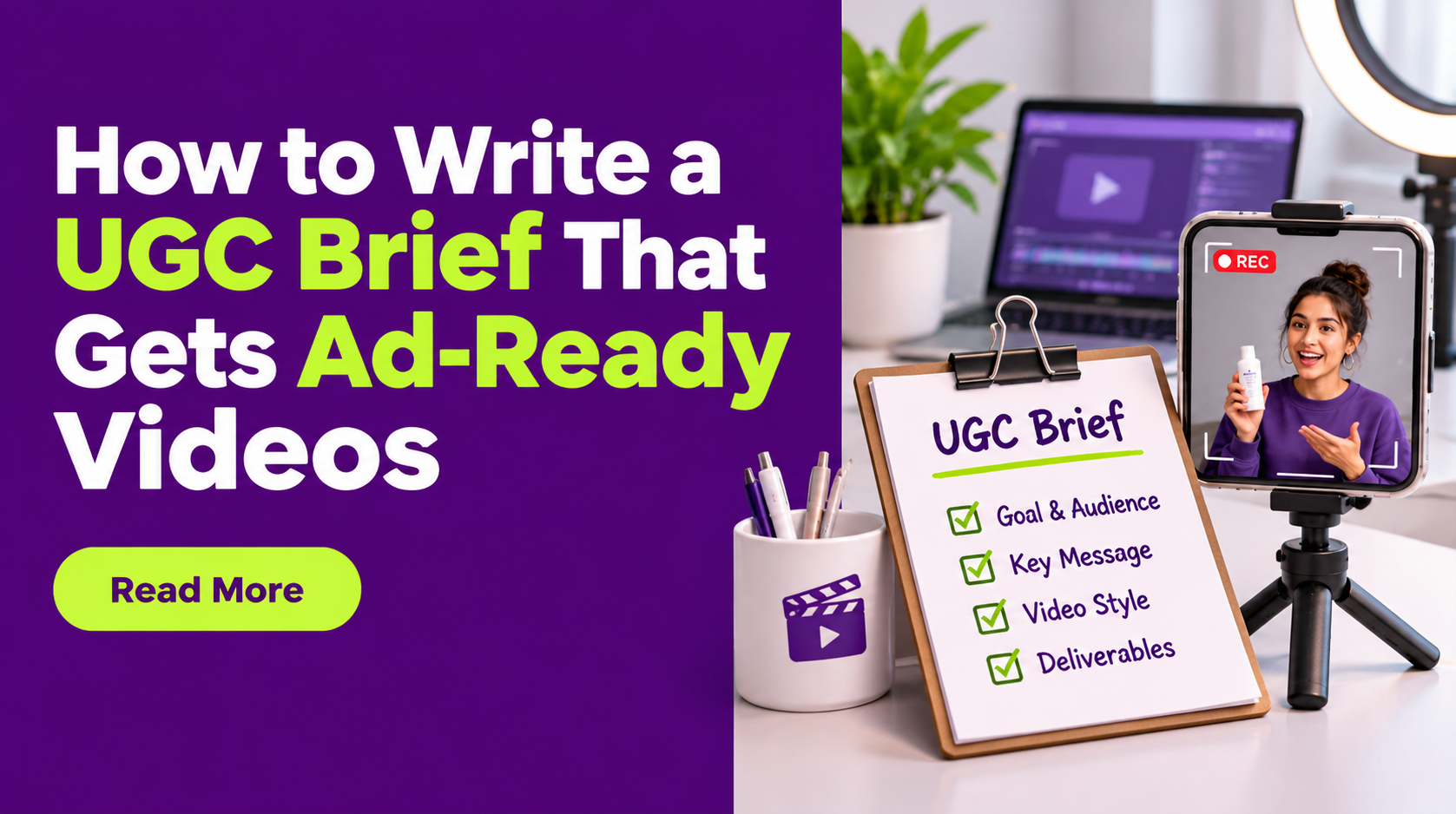
How to Write a UGC Brief That Gets Ad-Ready Videos (Free Template)
Quick answer: A good UGC brief tells the creator exactly what to make, who it's for and how it will be used, in one page. Include your product and offer, target customer, one key message, hook ideas, must-say and must-avoid points, video specs, number of hooks, usage rights, deadline and how revisions work. Use the free UGC brief template below to write yours in about 15 minutes.
Most "bad" UGC videos aren't the creator's fault. They come from vague briefs like "make a fun video about our product." The creator guesses, you ask for revisions, and a week later you still don't have an ad you can run.
A clear brief fixes that. It saves time for both sides, cuts revision rounds and gives you videos that are ready for Meta, TikTok and YouTube on the first delivery. In this guide you'll learn how to write a creator brief step by step, see what separates an average brief from an ad-ready one, and get a free UGC brief template you can copy into your next order.
What Is a UGC Brief?
A UGC brief (also called a creator brief) is a short document that explains what you want a creator to film. It covers the product, the audience, the message, the format and the rules. Think of it as the creative direction for user generated content: clear enough that the creator knows what success looks like, but open enough that their natural, authentic style still comes through.
A UGC brief is different from a script. A script tells the creator exactly what to say. A brief gives them the goal, the key points and a few hook ideas, then lets them deliver it in their own words. That's what makes UGC ads feel real instead of scripted.
Why a Clear Brief Matters for UGC Ads
• Fewer revisions. When creators know your must-say points and specs upfront, first deliveries are much closer to what you need.
• Ad-ready content. Specifying aspect ratio, length, hooks and captions means you can upload straight to your ad account.
• Fair, accurate quotes. Creators price based on deliverables and usage rights. A clear brief gets you accurate quotes and avoids surprise add-ons. (See our UGC rates guide for what's fair in 2026.)
• Better testing. Asking for multiple hooks per video gives you more angles to test without paying for new videos.
What to Include in a UGC Brief: 10 Essential Sections
1. Brand and Product Overview
Two or three sentences on who you are and what the product does. Add a link to the product page and any key specs (size, flavor, shade, price).
2. Campaign Goal
Say what the video is for: paid ads, organic social, a product page or email. A video for a cold paid audience needs a stronger hook than one for your existing followers.
3. Target Customer
Describe the person you're trying to reach: age range, lifestyle and the problem they have. "Busy moms who don't have time for a 10-step skincare routine" is far more useful than "women 25–45."
4. Key Message
Pick one main message. If you try to cover every feature, none of them land. Example: "It cleans your whole kitchen in under 5 minutes."
5. Hook Ideas
The first three seconds decide whether people keep watching. Give the creator two or three hook directions and ask them to film each one. Good UGC hook examples include:
• Problem hook: "If your skin feels tight after washing your face, watch this."
• Result hook: "This is my kitchen after 5 minutes with this spray."
• Curiosity hook: "I didn't expect a $20 product to replace my whole routine."
• Social proof hook: "Everyone in my comments asked what I use, so here it is."
6. Must-Say and Must-Avoid Points
List the claims, offers or phrases the creator must include (for example "free shipping over $50" or a discount code). Then list what to avoid: competitor names, medical or exaggerated claims, music you don't have rights to, or showing other brands' logos.
7. Format and Technical Specs
Be specific so every video arrives ready to post:
• Aspect ratio: 9:16 vertical for TikTok, Reels and Shorts (add 1:1 or 4:5 if you need feed ads)
• Length: 15–30 seconds for most UGC ads, 45–60 seconds for demos or tutorials
• Number of hooks: for example, one body with three different hooks
• Captions: burned-in captions or raw files without captions
• Files: edited video plus raw footage, if you plan to cut your own versions
8. Usage Rights
State where and how long you'll use the content: organic only, paid ads for 30 days, 90 days, 12 months, or a full buyout. If you want whitelisting or TikTok Spark Ads, say so here. Usage rights change the price, so creators need to know before they quote. Our guide to UGC usage rights explains each option.
9. Timeline and Delivery
Give a clear deadline, the date the product will arrive (if you're shipping it), and how files should be delivered. Most UGC videos take 5–7 days once the creator has the product.
10. Revisions and Approval
Explain how many revision rounds are included and what counts as a revision (for example, re-cutting or re-recording a line) versus a new video. Clear rules here prevent disagreements later.
Free UGC Brief Template (Copy and Paste)
Copy this UGC brief template into your next order or campaign brief, then fill in each line.
Brand and product:
[Brand name] makes [product], which helps [customer] [main benefit]. Product link: [URL]. Key details: [price, size, variants].
Campaign goal:
This video will be used for [paid ads on Meta/TikTok / organic social / product page].
Target customer:
[Age range], [lifestyle], who struggles with [problem].
Key message:
[One sentence the viewer should remember.]
Hook ideas (please film all):
1. [Problem hook]
2. [Result hook]
3. [Curiosity or social proof hook]
Must say:
[Offer, discount code, key claim, brand name pronunciation]
Please avoid:
[Competitor names, unapproved claims, copyrighted music, other logos]
Specs:
[9:16 vertical], [15–30 seconds], [number of videos] videos with [number] hooks each, [captions on/off], raw footage [yes/no].
Usage rights:
[Organic only / paid ads for 30 days / 90 days / 12 months / perpetual]. Whitelisting or Spark Ads: [yes/no, duration].
Timeline:
Product ships [date]. Draft due [date]. Final due [date].
Revisions:
[Number] rounds included. A revision means [definition].
Disclosure:
If you post this content on your own account, please use #ad or the platform's paid-partnership label.
Example: A Completed UGC Brief
Here's how the template looks filled in for a fictional skincare brand:
• Brand and product: GlowLab makes a gentle foaming cleanser that removes makeup without drying skin. Price: $24.
• Goal: Paid ads on TikTok and Instagram Reels.
• Target customer: Women 22–35 with sensitive or dry skin who are tired of cleansers that leave skin tight.
• Key message: "Clean skin that doesn't feel tight."
• Hooks: (1) "If your face feels tight after washing, your cleanser is the problem." (2) "Watch this remove full makeup in one wash." (3) "I've tried every gentle cleanser, and this is the one I repurchase."
• Must say: "Use code GLOW15 for 15% off."
• Avoid: Medical claims such as "cures acne," competitor names, trending audio.
• Specs: 2 videos, 9:16, 20–30 seconds, 3 hooks each, captions off, raw footage included.
• Usage rights: Paid ads for 90 days, plus organic use on brand channels.
• Timeline: Product arrives Monday, drafts due in 7 days.
• Revisions: 1 round included.
That one page gives the creator everything they need to deliver six testable ads (two videos × three hooks) on the first try.
Common UGC Brief Mistakes to Avoid
• Over-scripting. Word-for-word scripts make UGC sound like a TV ad. Give key points and let creators speak naturally.
• Too many messages. One video, one main message.
• Skipping usage rights. If you decide to run a video as an ad after it's delivered, you may have to renegotiate.
• No hook variations. Hooks are the cheapest way to multiply your UGC ads.
• Vague feedback. "Make it more fun" is hard to act on. Point to a timestamp and say what to change.
• Forgetting the product timeline. Creators can't film until the product arrives, so build shipping time into your deadline.
How to Use Your Brief on Vicomma
Once your brief is ready, you can put it to work in two ways on Vicomma:
1. Post a Smart Campaign. Paste your brief into a Smart Campaign with your budget and timeline. Matching creators apply with their price and portfolio, and you pick the best fit.
2. Hire a creator directly. Browse UGC creators, choose a package, and send your brief through in-platform messaging before work starts.
Either way, your payment is held in escrow until you approve the content, and you can request revisions before approving. Learn more about how Vicomma works, or check the FAQs for how revisions and approvals are handled.
Ready to get ad-ready UGC? Create a free brand account and post your first Smart Campaign brief today. No subscription, no platform fees, escrow-protected.
Frequently Asked Questions About UGC Briefs
How long should a UGC brief be?
One page is ideal. Long briefs get skimmed. Cover the goal, audience, key message, hooks, must-say points, specs, usage rights and timeline, and link to anything extra.
What's the difference between a UGC brief and a UGC script?
A brief explains the goal and key points and lets the creator use their own words. A script tells the creator exactly what to say. For authentic UGC ads, a brief with hook ideas usually performs better than a full script.
How many hooks should I ask for in a UGC brief?
Two to three hooks per video is a good starting point for ad testing. Many creators charge a small add-on for each extra hook.
Should I include usage rights in the brief?
Yes. Usage rights affect the price, so creators need to know whether the content is for organic posts, paid ads, whitelisting or a full buyout before they quote.
Can I use the same creator brief template for influencers?
Mostly, yes. For influencer posts, add details about posting dates, captions, tags, links and FTC disclosure, since the content will go on the creator's own account.
Final Takeaway
A great UGC brief is short, specific and focused on one message. Tell creators who the video is for, what it must say, how it will be used and what specs you need, then give them room to be themselves. Do that, and you'll get ad-ready videos on the first delivery instead of the third.