Social media in 2026 looks completely different from just two years ago.
What used to need production crews, editing suites, and weeks of lead time can now be done with text prompts and automated pipelines.
But the real revolution isn't just about making videos faster. It's about using AI to understand audiences so deeply that every piece of content feels tailor-made for the person watching it.
In 2026, AI-generated video is fundamentally changing how content is created, consumed, and monetized onlie. And the engagement layer sitting on top of it is just as transformative.
What Is AI-Driven Social Media Video Creation?
At its core, AI-driven video creation means using machine learning models to generate, edit, enhance, and distribute video content with little manual effort.
This includes:
- Text-to-video engines that turn written prompts into finished clips.
- Automated editing systems that cut raw footage into platform-ready pieces.
- AI voiceovers that sound genuinely human.
- Repurposing pipelines that turn one long video into dozens of short clips.
The shift has moved past experimentation.
In 2026, AI is no longer an experimental addition to video production it is a core strategy for businesses and creators who want to scale content creation, remain agile, and connect with audiences in meaningful ways.
The numbers confirm the change:
- 97% of marketing leaders now consider AI skills essential for social roles.
- More than 72% of marketers have already adopted AI video technologies.
- AI tools for captions, images, video editing, and chat agents are standard in most marketing stacks.
How It Works The Modern AI Video
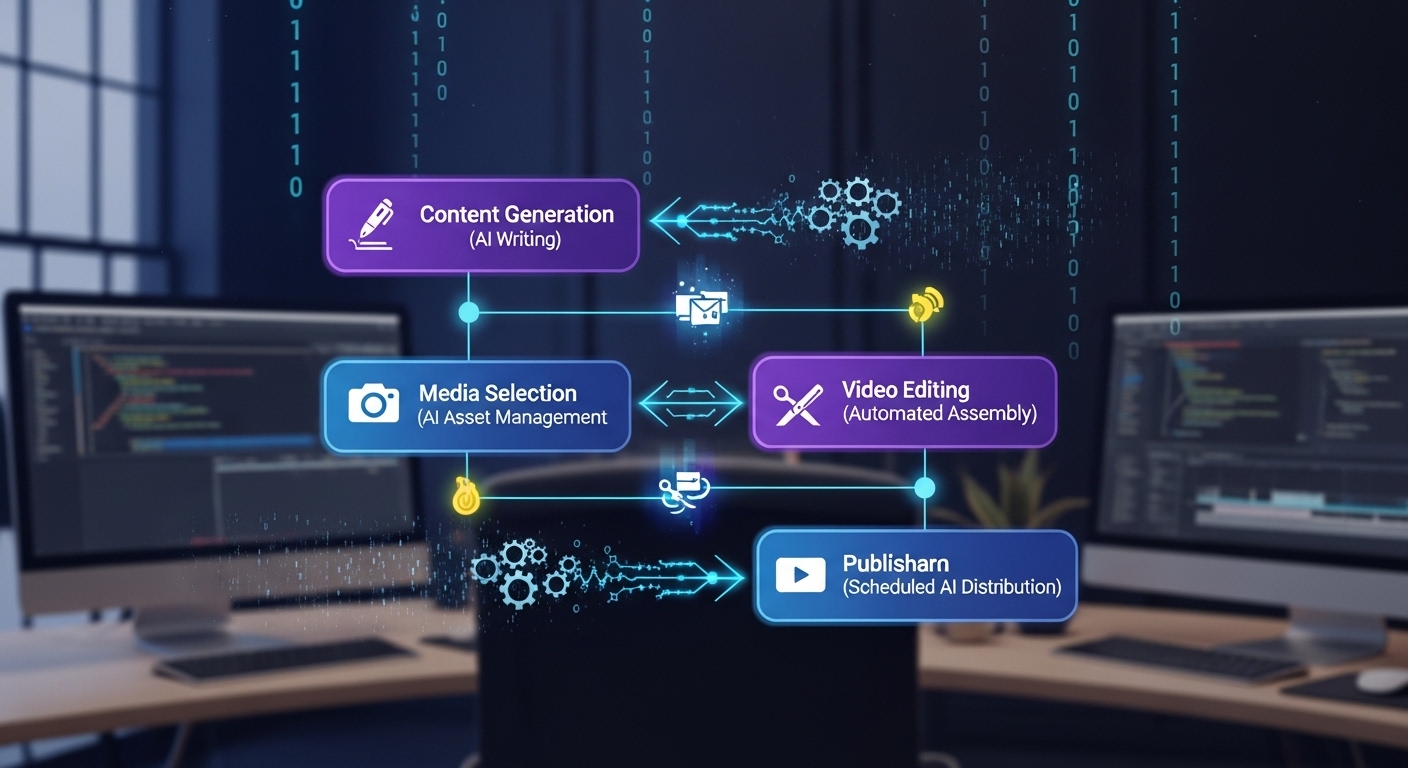
The production workflow of 2026 is radically different from the linear pipeline of the past.
Today, creators work in connected systems where ideation, generation, editing, and distribution all happen in parallel loops.
1. Text-to-Video Generation
This forms the foundation of modern video creation.
Modern platforms allow creators to guide scenes, camera movement, pacing, and tone with simple prompts, making it possible to produce high-quality videos consistently without traditional filming or editing skills.
Audio has caught up too. Native audio generation, where visuals and sound are created simultaneously, is becoming standard in 2026, eliminating hours of post-production work.
2. Automated Repurposing
One video now becomes many.
Creators can automatically transform a single long-form YouTube video into dozens of optimized clips for every major social platform, each sized and paced for TikTok, Reels, Shorts, or LinkedIn.
From script generation to thumbnail concepts and publishing workflows, AI video tools are increasingly designed to work together.
3. Workflow Automation
The economic impact is dramatic:
- AI video creators such as HeyGen cut production costs by up to 70 percent.
- Brands now post an average of 9.5 times daily across networks.
Without AI, this kind of volume would be impossible.
4. The Collapsed Pipeline
The deeper structural change is how workflows operate.
The linear brief-to-creative-to-production-to-edit pipeline has collapsed into iterative loops where ideation, generation, and refinement happen simultaneously.
Teams now test ten executed variations instead of choosing one direction theoretically.
Enhancing Audience Engagement Through AI
Creating video faster is only half the story.
The bigger shift in 2026 is how AI is rebuilding the relationship between content and audience. Every interaction is smarter, more personal, and more responsive.
Hyper-Personalization at Scale
Personalization is the biggest engagement driver.
Studies report that AI-driven personalization can connect with social media creators engagement by up to 30%, and brands that apply machine learning to targeting and ad delivery report social media ad performance gains of up to 50%.
How platforms do this:
- Platforms process billions of interactions each day, and AI-powered systems read those signals and rank content that matches user interest.
- AI drives over 80% of content recommendation.
- Meta's AI tools deliver a roughly 5% lift in conversions via nuanced targeting.
Looking ahead, personalized video feeds will replace generic content streams, and the internet will become more visual, interactive, and AI-driven than ever before.
Smarter Audience Intelligence
AI doesn't just deliver content. It understands who the audience actually is.
AI algorithms cluster audiences by interests, sentiment patterns, and visual context, going way beyond basic demographics.
Brands can now identify:
- Which customer segments discuss specific product features.
- Which communities drive word-of-mouth growth.
- Which audience groups show early warning signs of churn.
This intelligence extends to visual content too.
In 2026, customers talk about brands in images, videos, and visual contexts that traditional AI tools completely ignore showing products in Instagram stories without tagging, creating TikToks featuring logos without hashtags.
Modern AI social listening captures these visual signals that older tools missed.
Predictive Analytics and Real-Time Response
The old approach of analyzing campaigns after they ended is gone.
Instead of reviewing analytics after a campaign for lessons learned, brands can now use social listening to anticipate trends, respond to micro-shifts as they happen, and adapt messaging on the fly.
AI also forecasts what to post and when.
AI analysis helps brands share posts at times that maximize engagement and surface content that aligns with audience behavior, and supports predictive trend forecasting so brands can act on insights before trends peak.
For influencer campaigns, the accuracy is impressive. AI helps brands predict influencer performance outcomes with up to 85% accuracy.
Conversational AI and Automated Customer Interaction

Audience engagement is now a 24/7 responsibility. AI agents have stepped in to handle it.
Chatbots for Instagram and Facebook provide instant customer service, boosting engagement rates, and these bots learn from each interaction, becoming more effective over time.
The scale is striking Zendesk predicts automation could cover up to 80% of customer inquiries by 2027.
Smarter Copy, Captions, and Creative Testing
Small optimizations add up to major engagement gains.
AI-powered creative improvements include:
- Caption generation - posts with hashtags experience 12.6% more engagement, and AI tools systematically optimize for these signals.
- Personalized campaigns - AI enhances campaign personalization, increasing conversion rates by up to 20%.
- Faster production - AI content tools automate influencer posts, captions, and video edits, speeding up campaign production by up to 60%.
The Creator's New Role
Creators haven't been replaced. They've been elevated.
Creators are evolving into creative directors, guiding AI rather than manually producing content.
The winning formula has shifted. The creator with a "B+" video and an "A+" system will always outperform the creator with an "A+" video and no system.
But pure automation isn't the answer.
Research suggests content performs best when humans refine AI-generated outputs rather than fully automating creation. The future favors creators who collaborate with AI instead of competing against it.
Lazy use of AI actually backfires.
Those who use AI to cut corners and lower their standards will find themselves ignored by an audience that is increasingly sensitive to "AI-slop".
The Trust Problem
With AI this powerful, trust has become the defining challenge.
Over 70% of consumers worry about AI-generated fakes, and that skepticism extends to brands using AI without transparency.
Disclosure is now a competitive edge, not a compliance burden.
As AI-generated video becomes indistinguishable from traditional footage, clear communication about AI involvement separates trusted brands from questioned ones. In saturated AI feeds where everything looks polished, trust becomes the only remaining signal.
Data backs this up. 62% of global marketers believe labeling AI-generated content improves trust and performance.
What Comes Next
Three trajectories stand out for the rest of 2026 and beyond.
1. The market is exploding.
The AI video analytics market is expected to grow from $32.04 billion in 2025 to $133.34 billion by 2030 a 33% compound annual growth rate that confirms AI video has moved from experimental to essential.
2. Saturation will change what competition looks like.
AI video quality isn't the moat anymore creative direction is. As generation capabilities reach near-parity across platforms, the competitive advantage has shifted from what AI can create to how effectively creators direct it.
3. Human connection will matter more than ever.
AI tools are now table stakes but authenticity is the differentiator for successful brands and powerful consumer connections. While AI-driven workflows support effective content and campaigns, consumers crave social content with a human touch.